| SADC leaders head for the
Mozambican capital Maputo for the 19th annual summit to review the region’s
economic and political landscape which has changed in many ways since the last summit in
Grand Baie, Mauritius. “The summit will review the
political and economic situation in the region. On the political scene, the war in Angola
and the Democratic Republic of Congo (DRC) continue to be of concern. On the economic
situation, the summit will exchange views on trade and investment issues, debt crisis,
post-Lomé arrangement among other things,” said Kaire Mbuende, SADC Executive
Secretary.
The six countries with military forces in the DRC recently signed
a cease-fire agreement in Lusaka, raising hopes of a permanent solution to the conflict
that broke out 12 months ago. |
However, the rebels are yet
to sign the agreement, before it can be enforced. “We are hopeful that the rebels
will soon sign the agreement,” said Mbuende. The
situation in Angola, a country that has not known peace for the last 24 years, remains
worrying. The SADC Summit last year declared UNITA leader, Jonas Savimbi, a war criminal.
The Summit called upon the international community, particularly those countries and
leaders which have an influence on Savimbi, to persuade the rebel movement to honour the
Lusaka Protocol. However, limited progress has been made so far as the country remains at
war. |
On the economic side, the
executive secretary said significant progress had been made on the trade protocol, which
is considered the key to successful regional integration and economic development. The
Lomé convention, which expires in February 2000, is also expected to dominate economic
discussions. |
| by Fernando Goncalves The
concept of Spatial Development Initiatives (SDIs) is gaining a lot of currency in southern
Africa, where development corridors, aimed at facilitating the region’s transport and
communications systems are being implemented.
One of the most talked about of these initiatives is the Maputo
Development Corridor (MDC), which when complete, will link South Africa’s industrial
hub, Gauteng, to the port of Maputo, in Mozambique. The MDC, one of the five
infrastructural development projects between Mozambique and South Africa, has so far
attracted private sector investment worth US$400 million and generated more than 6,000
jobs since work began in 1998.
The other four SDIs are the Ressano Garcia railway network, the
Ressano Garcia-Komatipoort border post, the Mozal Aluminium Smelter Plant in Beluluane,
near Maputo, and the port of Maputo itself.
Of particular significance in the MCD project and others in
southern Africa still under consideration, is the joint public and private sector
participation. Last year, the MDC’s toll road project was awarded the highest rating
ever in project finance world-wide, for its ability to meet long term debt. The US$430
million, 440-km road is to be constructed, operated and maintained by Trans Africa
Concessions (Trac), with Nedcor Investment Bank and Investec of South Africa expected to
pay US$258 million.
The Development Bank of Southern Africa has provided US$40
million, while the governments of Mozambique and South Africa are to contribute to a total
of US$26.4 million and the Future Bank Corporation (FBC) has pledged US$39.6 million. |
A
consortium of Mozambican and South African investors have pledged to provide the remaining
US$13.2 million.
The SDIs became a priority immediately after the establishment of SADC in 1980, and were
intended to make the region more independent of the transport and communications system of
apartheid South Africa, then seen as the region’s main destabilising factor.One of the most important projects identified then was the Beira
Development Corridor, linking Mozambique’s port city of Beira and Zimbabwe, which was
also expected to benefit other states in the region’s interior, such as Botswana,
Malawi and Zambia. The Beira Corridor project included the upgrading of the road and
railway between Beira and the Zimbabwean border, as well as the deepening and development
of the port of Beira itself.
Meeting of SADC Ministers of Finance
and Investment: Communique
Trade intergration on course - Mbuende
Region needs to reverse negative
perceptions to attract investment
Mozambique: SADC's gateway to the
best
All that glitters is not gold
Bulawayo-Beitbridge railway launched
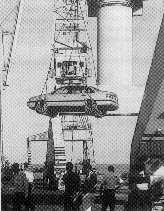
Offloading cargo at Maputo port, Mozambique
|
The
Nacala Development Corridor is another important project. It links the seaport of Nacala,
in Mozambique’s northern Nampula province, and Malawi. Transport ministers from
Malawi, Mozambique, Tanzania and Zambia met at the end of July in Dar es Salaam, to
discuss ways to expand the project including all four countries, and prepare for the
October donors’ conference, which is expected to mobilise funds before implementation
gets underway next year. Malawi, Mozambique, Tanzania and
Zambia are also involved in the development of the Mtwara Corridor, which seeks to improve
the port of Mtwara, in southeast Tanzania. Negotiations on the development of the corridor
began in November last year, and when completed, the project is expected to boost trade
and investment in the four countries, and at the same time creating jobs.
The four countries have already began work on the corridor,
starting from the Tanzanian side, which is seen as having great potential for trade and
investment, through the interlinkage of trade routes and the development of tourism, as
well as improving the lives of local populations.
A project document presented at a recent meeting in the northern
city of Pemba, in Mozambique, with the participation of the private sector, says the
Mtwara Development Corridor will include the improvement of the port of Mtwara, and the
road and telecommunications network.
The port of Mtwara is strategically situated, touching on northern Malawi and Mozambique,
as well as the eastern part of Zambia. |
