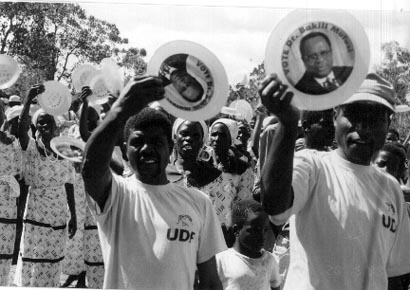
| Malawians
turned up in their thousands, some as early as 2 O’clock in the morning, to exercise
their democratic right in the country’s second pluralist election won by President
Bakili Muluzi, who ousted late dictator Hastings Kamuzu Banda in 1994. While anger and disbelief permeated the opposition camp after the June 15
presidential and parliamentary elections, jubilation and relief punctuated the victorious
ruling United Democratic Front (UDF).
Official results, announced 72 hours after the polls, showed
President Muluzi winning with 2.4 million votes, his closest rival Gwanda Chakuamba of the
opposition alliance constituting the Malawi Congress Party (MCP) and the Alliance for
Democracy (AFORD) standing at 2.1 million.
On the parliamentary front, UDF took 93 seats, MCP 66 and AFORD
29, to an increased national assembly of 193. At the time of writing, one seat was not
contested following death of one of the candidates juts before the polls.
As predicted by most analysts, the 5 million registered voters
maintained ethnic and regional loyalties exhibited in the country’s first multiparty
polls of 1994.
The phenomena was pronounced in the 1994 elections when Malawi
moved from 31 years of one-party, strong-handed rule of late dictator Banda, to a
pluralist system of government. The UDF under Muluzi won the majority seats with 85 seats,
MCP 56 and AFORD 36 in the 177 seat national assembly.
The UDF’s stronghold is the southern region which has 4.6
million people while the MCP — the biggest opposition party — commands the
central region which has 4 million people. One million people are domiciled in the north,
AFORD’s enclave.
Of the five million registered voters, 2.4 million were in the
south, 1,975,203 in the central and 678,906 in the northern regions.
The MCP leader Chakuamba, who was contesting the presidency, took
AFORD’s Chakufwa Chihana as a running mate, a pairing that the opposition expected
would yield a superior tally of votes, but did not work.
|
Though a southerner and a
former detainee under the one-party regime, Chakuamba’s biggest mistake seems to be
his embrace of the MCP, a political organization tainted by alleged human rights abuses
under Banda. Although MCP has increased its seats to 66 from
56 in 1994, benefiting from sections of the electorate disgruntled by the pains of
structural adjustments, it was unable to cover enough ground to gain power.
The opposition resorted to petitioning the Supreme Court over the
result.
However, Malawians hope the legal battles do not drag on and on as
the government has many challenges to solve. The central statistical office puts inflation
at above 50 percent, and with a gross domestic product (GDP) per capita of US$180, Malawi
is among the poorest countries in the region.
“There is no question Malawi is a poor country. As such
poverty eradication is the preoccupation of the government after the elections,” said
Dr Exley Silumbu, Chief Economist of the Malawi Chamber of Commerce and Industry (MCCI) in
Blantyre, the country’s commercial hub.
Malawi’s economy is largely dependent on agriculture, which
accounts for 40 percent of GDP and is the source of 80 percent of all export earnings.
Tobacco, which brings in just under two-thirds of Malawi’s
export earnings, has slumped on the world market, plunging the country into a foreign
exchange crisis. |
Latest projections from
MCCI indictate that tobacco sales in 1999, at US$176 million, will be 16 percent shy of
1998 figures. In 1998, tobacco sales fell by US$80 million. “This
is going to put pressure on the Malawi kwacha, which depreciated by 60 percent between
1998 and 1999,” said Dr Silumbu, adding that the only hope is on the promised aid
from the World bank and the International Monetary Fund.
The Bretton Woods institutions recently pledged a record US$1.3
billion for the southern African country, a move analysts described as a seal of approval
for President Muluzi’s commitment to economic reforms.
However, like most countries that have toed the IMF line, the
reforms have not been without victims. Crime, inflation and unemployment are rising, and
ordinary Malawians are beginning to feel the pinch.
But Muluzi remains adamant these are unavoidable short term
hardships during the transitional period. The country stands to benefit in the long term,
he says.
On the political side, the real challenge will be to reconcile the
differences between UDF and the MCP-AFORD alliance which, together, form a simple majority
in parliament. “It will be in the best interest of all Malawians that they (political
parties) work together,” said one taxi driver.
And with the national budget scheduled for July, the ruling UDF
will have to muster the skills of engagement with a bitter opposition to raise the country
above the uncertainties that haunt it. |