| by Kondwani Chirambo Touted
as Africa’s largest, most technologically advanced media operation to cover an
election, South Africa’s election centre was replete with strobe lights, dozens of
television cameras, hundreds of computers and giant electronic screens monitoring results
hourly.
More than 1,200 journalists reported South Africa’s
second all-race elections on 2 June and all were catered for in a massive structure in
Pretoria’s showgrounds — transparency was the rule in these elections. The South
African Broadcasting Corporation (SABC) put up an impressive high-tech round-the-clock
show, including regional broadcasts in each of the nine provinces and which showed former
President Nelson Mandela and new President Thabo Mbeki and party leaders casting the vote
at the break of dawn on 2 June.
Amina Frense, SABC’s
Deputy Editor of elections, said the corporation had collaborated with computer firms to
introduce “some very impressive software”. “It will be quite interesting
and very high tech.… and its made in Africa,” she said just before the election.
The Independent Electoral Commission’s (IEC) election centre was festooned with 600
computers, 27 servers, 2,000 telephone lines, 8 kilometres of cabling and could take up to
3,000 people at a time. |
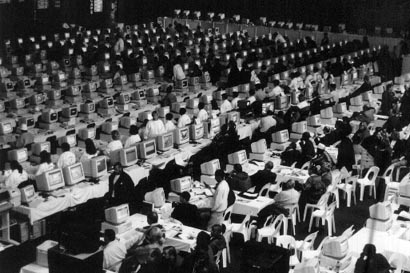
Banks of computers at Pretoria's election centre |
| “This is paid for by
the IEC and some private enterprise but we cannot give the cost,” said an election
official from the Media help desk — one of several points attending to various
queries from journalists. Two separate screens occasionally flashed time-tables for
various press conferences from the several party and government leaders. In the expansive
country with a land area of 1 223 201 square kilometres and a population of 43.2 million,
policing an election in the historically trouble-torn townships of Kwa Zulu Natal or any
of incidental flash-points around, could have been a logistical nightmare. |
But 100 000 policemen and
army personnel, otherwise dubbed “peacekeepers”, kept close watch over the
proceedings. No major incidents threatened the election. Dozens of helicopters gave back
up to the ground force and ensured the polls were conducted peacefully. |
In a diplomatic drive to
promote transparency in regional elections,
the SADC Electoral Commission’s Forum (ECF) is exploring the possibility of sharing
technology to ensure a more efficient, open delivery of results in the 14-member SADC
region.Inspired by the high-tech display in the 2 June
South African elections, where the Independent Electoral Commission’s Results Centre
brought an hourly update of vote patterns across the country to hundreds of media,
observor groups and the public via giant electronic screens, the ECF has discussed the
issue of “technology transfer” from one country to the other, according to a
senior executive member.
Bishop Ralph Hatendi, executive member of the SADC Electoral
Commission’s Forum recently said that technology was the heart of a speedy and
transparent electoral process.
He was speaking from Malawi where the SADC forum was observing the
recent election in Malawi, which by contrast, was limited in terms of technological
capacity to deliver results promptly. |
“There are certain
things that are transferable from country to country, and they can cut on costs. This has
been discussed by the forum because we believe there must be transparency right through. If we share technology we can make the electoral process much more
efficient and transparent”, Hatendi said, who is also Chairman of the Zimbabwe
Electoral Supervisory Commission.
The SADC Electoral Commission’s Forum was launched in July
1998 in Cape Town and comprises 12 electoral commissions of the SADC region.
The Forum aims to foster cooperation between members as a way of
promoting a culture of democracy and free and fair elections. Its membership includes
research institutions, universities, non-governmental organisations and diplomatic
structures serving in their individual capacities. |
The Forum’s Observer
Mission covers all the relevant aspects of the conduct of elections in line with a
particular country’s laws and makes an assessment whether the people had freely
expressed their will through the vote. “The success of
the mission is highly dependent on the willingness of the people of the country to share
with the mission members their experiences, opinions, feelings and observations about the
electoral process,” a spokesperson said.
The Mission covered elections in Lesotho in 1998 and South Africa
earlier this month and is, according to Hatendi, geared to travel to Botswana, Mozambique
and Namibia which are still to hold polls later this year.
Whole new era of South African politics
as ANC wins big
High-tech media operation covers SA polls
SADC forum promotes electoral transparency,
accountability
Entrenching a democratic culture
President Muluzi wins second term |