| by Hugh McCullum 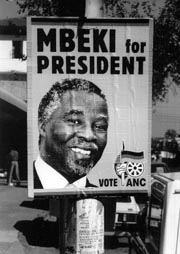
The winning posters for ANC
The euphoric celebrations are over
and South Africa’s President
Thabo Mbeki is back hard at work in his ornate gothic offices in the Union Buildings in
Pretoria, a host of national, regional and international issues demanding attention —
issues which will impact on southern Africa and the continent for years to come.
Sworn in at a glittering ceremony on 16 June, the Mbeki era will unquestionably be
different in style from those of his charismatic predecessor, Nelson Mandela. But the
policies and programmes of the African National Congress
(ANC) government will continue albeit with a much greater sense of urgency and
transformation because the people have given them an “unequivocal” mandate for
another five years.
ANC goes into the 400-seat Parliament with 266 seats after the June 2 marathon
election, one short of a two-thirds majority. The remaining seats are split among 12 other
parties with the white liberal Democratic Party (DP) narrowly taking the position of
Official Opposition with 38 seats, just ahead of the Inkatha Freedom Party (IFP) which has
34.
What this election showed is the maturity of South Africans less than a decade after
half a century of racist apartheid. The extremes are falling away, the ANC is hugely
popular and the voters are filled with optimism. The system works. As an emotional Mbeki
said when he stepped before his frenzied supporters out in the Mid Rand’s ANC offices
“the women, the poor, black and white, all colours and all sectors of South Africa
have unequivocally given ANC a further mandate.” He told cheering ANC members
“the poorest of the poor have said they trust ANC to help them out of their
conditions of misery. The masses of our people have mandated us to maintain the peace and
stability which democracy and good governance have bro-ught our country.
However, with the euphoria over, Mbeki must consolidate and transform the Mandela era
into the Mbeki era. The cabinet has changed, but policies especially economic, employment
and crime must continue and consolidate. |
“Mbeki needs a strong
mandate to be able to administer the strong medicine that is needed by the weakening
economy and the equally strong medicine needed to substantially reduce runaway urban
crime,” said economist Patrick Mchunu of a Sandton-based investment house. Mbeki made
few sweeping promises on the campaign trail and he assured people that ANC would
accelerate the delivery of services, although governed by a budget of fiscal restraint. He
also pledged to fight rampant corruption within his own ANC ranks and raging urban crime
but said the success of this campaign would depend on community support and participation.
He raised the question about what has gone wrong with morality in South Africa where
corruption and crime including violence and sexual abuse have loomed large. Voters were
obviously convinced that Mbeki was the right man to fill Mandela’s shoes, although
Mbeki himself says “I will never grow my feet nor wear flowered shirts” in
reference to Mandela’s relaxed mode of dress. 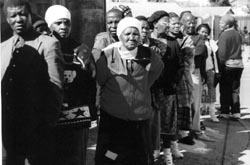
Patience was a virtue in the slow moving queues
Mbeki is generally credited in London and New York as the architect of post-apartheid
reforms in the economic, mining and financial sectors which have opened South Africa to
the global economy. Business seems confident in the GEAR (growth, employment and
redistribution) programme but anxiously awaits, as do most voters, to see it delivered in
concrete terms. Mbeki has spoken often of an African renaissance, of transformation both
at home and in southern Africa and the continent in concrete terms. That means a better
life for a country, a region and a continent that is at a crossroads. The ANC, the people
said in overwhelming terms, is the party that can start delivering the benefits of
democracy — better jobs, houses, health, education, massively reduced crime and
corruption — and it must do it soon. As one analyst put it: “The feel-good days
of Mandela are over. It’s time to roll up the sleeves and go to work.”
The concern of some observers is that the new administration will concentrate so much
on domestic economic and social issues that it will fail to bring its unquestioned
leadership in business, technology and wealth to bear in a positive manner on SADC and the
rest of the continent. Early indications are that black empowerment will grow, that the
markets are not afraid of ANC’s massive majority, that privatisation will move ahead
and that foreign investors are keen to see if they are welcome to help drive economic
growth in the country and region. |
With economic growth
predicted at little more than 0.5 percent in 1999 and unemployment estimated to be well
above 30 percent the economy is the issue, but not the only one by any means. The
rationalisation of industry and the sale of parastatals will be paramount in the face of a
more competitive international environment. The bloated public service inherited from
apartheid days has not been dealt with, the dwindling contribution of gold to the fiscus
and the vulnerability of the emerging local economy to the global marketplace have forced
the issue of unemployment to the top of the political agenda. Pressure from allies in
the trade union movement forced Mandela to temper his economic policy of strict fiscal
discipline and debt reduction in the hope of creating more jobs. Mbeki’s regime will
face even more severe pressure.
Along with unemployment come the attendant social problems of crime, spousal and child
abuse, corruption, decay and poverty. With the bulk of the national budget going either
for salaries or debt repayment, there is simply little left to meet the aspirations of the
millions of South Africans who suffered so long under apartheid and who continue to
suffer. However, these problems and many more are solvable, the masses decided on June 2.
The Mbeki years are just beginning but the miracle of democracy in South Africa which
was literally wrenched from a vicious and racist regime has made people believe that if
they could survive apartheid, they can survive anything. With the spirit of renaissance
and hope, South Africa could well provide the spirit of reconstruction, development and
harmony which could bring a more promising future to southern Africa, the continent and
the world.
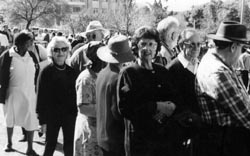
In wealthy Sandton, voters also had to queue
High-tech media operation covers SA
polls
SADC forum promotes electoral
transparency, accountability
Entrenching a democratic culture
President Muluzi wins second term
|
