 |
 |
|||||||||||
 |
||||||||||||
 |
 |
 |
 |
 |
 |
|||||||
 |
 |
 |
 |
|||||||||
 |
 |
| ||||||||||
 |
|
|
|
|
|
|
|
|
||||


| Home | Contact Us | Archive | Comments | Related Websites | REDI | SARDC |
|
|
Zambezi Watercourse Commission: The origins and purpose
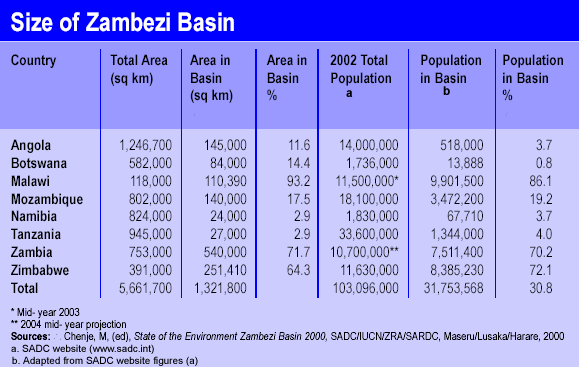
The signing of the Zambezi Watercourse Commission agreement on 13 July is one of SADC’s achievements toward poverty eradication and economic development as outlined in the Regional Indicative Strategic Development Plan (RISDP). The agreement was signed in Kasane, Botswana, by ministers responsible for water from seven of the eight riparian states -- Angola, Botswana, Malawi, Mozambique, Namibia, United Republic of Tanzania and Zimbabwe. Zambia did not sign but pledged to do so before the August SADC Summit after further consultation at national level. SADC has identified poverty reduction as the number one priority on its integration agenda, and the launch signifies strategies for poverty reduction through shared resources including water. The Zambezi Commission is one of the goals set for the Zambezi Action Programme (ZACPRO6), that seeks the participation of all riparian states in making decisions on the management of the river basin. The Commission also seeks to demonstrate that management of the basin should not be restricted just to the river and its immediate environment but to every aspect of development. ZACPRO is a product of the Zambezi River Action Plan (ZACPLAN), adopted in 1987. ZACPLAN has 19 projects, of which ZACPRO6 is at the core. ZACPLAN resulted from the realisation that as demand for the basin’s water resources increases in the riparian states, so will competition to utilise the basin profitably and therefore the possibility of conflicts. The first phase of ZACPRO6 involved the collection of information on water quality and quantity. This was based on the understanding that the basis for planning is information. Strategies had to be developed to ensure that reliable information and data were provided in a format and in sufficient detail to be suitable for the management systems developed. Coordinated by the SADC Secretariat under ZACPLAN, negotiations for the establishment of the Zambezi Commission were concluded in Windhoek, Namibia in March this year. The negotiations date back to the late 1980s although these were suspended in the early 1990s to allow for discussions on the SADC Protocol on Shared Watercourses, signed in 1995. The protocol was revised in 2000 and ratified in 2003. Fresh negotiations around ZAMCOM resumed in 2002. Four rounds of talks were held between 2002 and 2004 in South Africa, Mozambique, Zambia and Namibia. The negotiations were complemented by specialised technical activities, as well as high level ministerial consultations that took place in Ethiopia and Mozambique in September and November 2003 respectively. The objective of the Commission is to promote the equitable and reasonable utilisation of the water resources of the Zambezi Watercourse as well as efficient management and sustainable development. The commission will be governed by three organs: the Council of Ministers, the Technical Committee, and the Secretariat. The Council’s main role will be to adopt policies and decisions and to provide necessary leadership during implementation while the technical committee will implement policies and decisions of the Council. The Secretariat will provide technical and administrative services to the Council under the Technical Committee’s supervision and facilitate the development of a strategic plan, annual work programme, plans, studies, assessments and other documents required for the implementation of the agreement. The Nordic Cooperating Partners of Swedish International Development Cooperation Agency (Sida), Danish International Development Agency (DANIDA) and Norwegian Development Aid (NORAD) funded the ZAMCOM negotiations.
|
|
|
SADC Today, August 2004
|
|
Any comments or queries about the content of this page,
contact sadctoday@sardc.net Comments and queries regarding the page itself, contact the Web Applications Developer. |
|