| by Pamela Chinaka Following
last year’s disputed election results, political stakeholders in Lesotho are engaged
in debate for change in the electoral system, with a view of coming up with a more
democratic and representative model for next year’s multi-party elections.
Negotiators during last year’s political impasse that
resulted in violence established an Interim Political Authority (IPA) to represent all
political parties that contested the 1998 elections.
The authority is to prepare for next year’s general elections
in consultation with government. It also has powers to review the electoral process.
Until now, the mountainous kingdom – like most former British
colonies - has been using the Westminster First-Past-The-Post (FPTP) system in which to
win a parliamentary seat the candidate only needs to get the majority of the votes
regardless of how many they are.
A number of opposition parties, led by Basotho National Party
(BNP) feel that this system gives all the power to one party, thus, they are convinced the
Proportional Representation (PR) system will accord every party an opportunity to be
represented in parliament.
In the PR system, a party’s share of national votes is
translated into a corresponding proportion of seats in parliament.
Unlike the FPTP system where the vote for a nominated candidate in
a constituency, in the PR system, parties list candidates to the electorate and voters
vote for a party, which later gives listed candidates seats in accordance with their
position on the list. This is the system used in South Africa. |
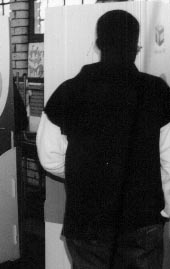
A SADC citizen exercises his democratic right.However, the ruling Lesotho Congress for Democracy does not see anything
wrong with their present electoral system, and feels the PR system being advocated for by
some opposition parties is undemocratic.
“This system is undemocratic as it deprives the electorate
the right to choose the candidate of their own at constituency level. Parties impose
candidates upon the electorate,” says Prime Minister Pakalitha Mosisili.
But the BNP and other opposition parties opposed to the status quo
disagree saying they are in fact advocating for democracy as their proposed system will
ensure that every party is represented in parliament and independent candidates can also
be voted into the legislative assembly.
“We are trying to democratise the system of voting, but
others want to monopolise it,” argues the Secretary General of BNP, Majara Molapo. |
In a statement recently,
five parties under the banner “Khokanyane-Phiri” dismissed calls by BNP for
Proportional Representation saying they were in favour of a Dual Model which takes
elements from both PR and FPTP systems. “A dual model
which takes both PR and FPTP systems is the only one which respects and gives equal rights
and opportunities to candidates and contesting parties alike,” the statement said.
Political parties have taken the debate on electoral systems to
the public and are busy trying to convince the electorate to subscribe to an electoral
system that advances their (political parties’) interests.
Of the 80 seats contested in the last election, the ruling LCD won
79 seats representing 60 percent of the votes cast, whilst BNP won only one but with 25
percent of the votes cast. Other parties could not secure seats, but managed to get up to
ten percent of the votes cast.
Political upheaval and riots rocked the country in protest against
the results, threatening peace and stability.
Democratic Republic of Congo: Can peace
prevail?
SADC in the next millenium: Working
together for peace, progress and prosperity
SADC Day celebrations to precede Maputo
summit
|