Women in
politics and decision-making:
Beyond 30 percent by the year 2005by Luisa Banze |
Mtintso agrees
if the quota system is preoccupied with handpicking people to make up numbers, then that
is tantamount to “setting women up for failure and endangering the cause of gender
equality”. She believes a balanced approach that looks at the person’s potential
to develop and her commitment to gender transformation is necessary. “While this does
not imply that women who enter parliament are representatives of women, they however, like
men, as public representatives, have to be committed to the transformation of gender
relations in society.” Other mechanisms have to be put
in place to ensure that women who have managed to join parliament can compete favourably.
This includes removal of constraints to their participation and
effectiveness. Although member states have begun addressing the women’s concerns, a
lot still needs to be done. As Margaret Nasha, president of the Botswana Caucus for Women
in Politics, and Minister of Local Government and Lands, says “unless we work hard to
reach the 30 percent target ourselves and be serious about it, this target dream, will
remain only a dream”.
Customary Law in southern Africa
Day of the African Child
sinking into oblivion?
The ideology of militarism and human
security
The SADC trade protocol & gender:
What are the connections? |
| The achievement
of 30 percent representation of women in politics and decision-making structures by
the year 2005 is a major challenge that all countries in the southern African region still
face. It is a challenge that will transform the power relationships between women and men. This target percentage is stated by the Heads of States and Governments of SADC countries in their 1997 Declaration on Gender and
Development, where they commit themselves to “ensuring the equal representation of
women and men in the decision-making of member states and SADC structures at all levels,
and the achievement of at least a 30 percent target of women in political and
decision-making structures by the year 2005.” Available statistics clearly illustrate
the limited participation of women in structures of power and decision-making at all
levels of the society. For instance, the average percentage of women in parliament in the
region, excluding the Democratic Republic of Congo (DRC), is 17 percent, which is well
above that of the Commonwealth which has 7.2 percent and the global average of 11 percent.
However, only three southern African countries are significantly
close to the 30 percent target: Mozambique, at 28 percent, South Africa 26.2 percent
(before the elections) and Seychelles 24 percent are the closest. The cabinet figures are
as low as 2.7 percent in Mozambique, which however, has done well at parliamentary level.
At the managerial level, again women are only seen in middle and lower positions and with
very few in top management of the public service, parastatal organisations and private
sector.
Dr Kaire Mbuende, SADC Executive Secretary says the absence of
women in key leadership positions puts to question the issue of democracy in the region.
“It is in fact an indictment on our commitment to democracy
that women, who constitute the majority of the population and who do most of the
backbreaking work at the grassroots in most political parties in the region, remain under
represented in leadership”.
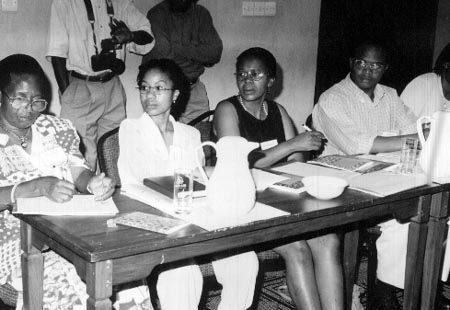
In furtherance of the SADC objective, a conference on Women In
Politics and Decision-Making: Beyond 30 percent in 2005 was held recently in Botswana. The
objectives of the conference were, among others, to:
- Identify the various levels of decision-making which are key to the realisation of
equality between women and men, and adopt a regional action programme aimed at increasing
the representation of women in decision-making in SADC through affirmative action, as well
as enhancing their capacity once in these positions; and
- Identify and document various governmental, NGO and other initiatives with a view to
establish a regional network of women in decision-making, as well as organisations working
in this field.
|
Macharia Kamau, UNDP resident representative in Botswana, believes with
adequate effort, the target is achievable. “For the 30 percent quota to be realised,
there is need for positive affirmative action, advocacy and pro-activism. With concerted
efforts from all the SADC member states, bilateral and multilateral co-operation partners,
the challenge is not insurmountable.” The absence of women in leadership positions is
generally seen as counter productive, not just in economic terms but even politically. For
instance, as one woman says, countries involved in conflicts could benefit immensely if
women were allowed to act as negotiators. “Women are
generally peace loving. They have patience and they believe in dialogue. If they (women)
were involved as key political negotiators we would probably have a different story about
the situation in Congo,” she says. Thenjiwe Mtintso, the ANC Deputy Secretary-General, concurs. She says the
importance of the inclusion of women in parliament is that women have different values
from those of men. “These perspectives and values would change the character of
parliament and impact on the kinds of policies that are made. Women also have different
interests as a group which have to be presented in parliament by women themselves.”
There have been fears in some circles that the quota system is not a long-term solution as
it seeks to address quantitative rather than qualitative issues. This notion further
argues that the women’s cause at the end of the day will not benefit as the appointed
women remain ineffective as participants.” |