| by Fernando Goncalves WScholars
have in recent years tried to grapple with the question of re-defining the concept
of security, in an attempt to move away from the state-centred notion which places greater
emphasis on the military and acquisition of hardware.
New definitions of security include what some scholars now call
‘human security’, embracing such notions as the need to invest in the human
being by way of improving the security of the individual, increased access to social
services such as health, education and social welfare.
The predominance of the realist paradigm of security, as the old
notion is known, implied that security became subsumed under the rubric of power, based on
the assumption of a hard distinction between domestic ‘order’ and international
‘anarchy’, a ‘state of nature’ where war is seen as an ever present
possibility.
In the new security debate in southern Africa, there have been
persistent calls for countries to engage in a meaningful process of demilitarisation, in
the form of reduction of the military establishments and for the need to re-direct
resources from financing huge armies towards investment in social development sectors.
However, there has been opposition from some sectors, particularly
from those who insist that the issue in southern Africa cannot be that of
demilitarisation, because the region is not, in the true sense of the word, militarised.
According to this line of thinking, what is needed is not
demilitarisation, but a process through which there is a balance between meeting the
pressing economic and social needs of the majority of people while taking care of the
security needs of the state.
This is the state-centred position, as once articulated by the
former South African minister of defence, Joe Modise, when he called on SADC states to
build up their armies.
Modise argued then that the region needed to arm itself so that
the responsibility of peace keeping did not lie with any one country and for it to be able
to protect stability and attract investment. |
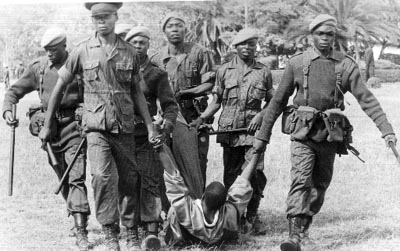
The new security debate in southern Africa is whether to
redirect resources from financing armies towards investment in social development sectors |
| “No right thinking
person would invest in a country that cannot protect itself,” Modise was then quoted
as saying. And at a time when Botswana was heavily on the spotlight due to its large scale
arms purchases, one of its opposition leaders, the president of the Botswana Congress
Party (BCP), Michael Dingake, had this to say: “Though I do not know what they (the
arms) will be used for, I am not sure we need them … however we must be on our
guard”. At a recent workshop in Windhoek, jointly
organised by the University of Cape Town’s Centre
for Conflict Resolution (CCR) and the Berlin International Centre for Conversion (BICC),
the participants were unanimous in their call for demilitarisation and for southern Africa
to seek more novel ways of maintaining peace and stability in the region.
They did point out, however, that for demilitarisation to be
meaningful and comprehensive, it has to be a collective effort, in which those countries
with greater military capabilities should take the lead.
For example South Africa alone is said to have exported US$260
million worth of arms in 1997, including over US$20 million to African countries such as
Congo Brazzaville, Rwanda and Uganda.
Additionally, for demilitarisation to be successful it has of necessity to be mass based,
involving as it should the demilitarisation of civil society as well.
Health ministers sign co-operation
protocol
DRC: Ilunga new rebel leader
Angola: Concern over humanitarian
conditions
SADC peacekeeping centre opened |
There has been a tendency
to take demilitarisation in the classical sense of the term, which implies reduction in
arsenals and scaling down of military personnel. However, in
southern Africa, the region remains highly militarised even if in terms of the BIC3D Index
it has over the years been able to reduce military expenditure by 30 percent, weapon
holdings by 13 percent, armed forces by 8 percent, and employment in arms production by 41
percent.
The BIC3D Index is a combination of data on military expenditure,
holding of selected weapon systems, armed force personnel and employment in arms
production, to indicate a global trend in demilitarisation.
However, a significant number of small arms still remains in the
hands of civilians in many parts of southern Africa, creating a serious obstacle to peace
building. “Throughout the region small arms are often the basis of a militarised
identity that is lethally connected to culture, gender, political ideology, ethnicity,
race and nationality,” says Professor Jacklyn Cock, of the University of Witwatersrand.
This contradiction between institutional demilitarisation and the
proliferation of arms within civil society has to do in part with the privatisation of
militarism, which is manifest in the growth of private security firms, a re-working of the
ideology of militarism, and new forms of violence and conflict. |