
| Is SADC ready for trade reciprocity
with the EU? |
| A proposal has been put
forward by the European Union (EU) to gradually introduce reciprocal trade between the
15-member group and sub-regions within the African-Caribbean-Pacific (ACP) group of
developing nations when the Lomé Convention provisions fall away in February 2000. The EU has identified six sub-regions in the ACP group with which to create
Regional Economic Partnership Agreements (REPAs). Because of its ultimate objective to
establish a single economic space, SADC is one such region which has been earmarked for
the proposed agreements, which, according to the EU, should be compatible with the World
Trade Organisation (WTO).
SADC, along with other ACP countries, are currently enjoying
preferential access to the European markets under the Lomé Convention which has been in
place since 1975 and will expire next year. Official negotiations for a new framework of
agreement commenced in September last year.
SADC, along with other ACP countries, has indicated that it wants
the status quo maintained or even bettered.
On the other hand, the EU has shown that it would want the current treaty replaced with
something that is WTO - compatible or precisely, an agreement based on reciprocal trade.
To this end, the EU put forward a proposal for gradual
introduction of reciprocal trade with sub-regional groupings such as SADC. After a SADC-EU
meeting in Brussels last year, the SADC committee of
ambassadors called on organisations involved in policy research
and related fields to critically examine the implications of such an option.
In response to the appeal by the SADC Committee of Ambassadors, a
workshop was convened by the Foundation for Global Dialogue and the South African Trade
and Industrial Policy Secretariat (TIPS) in Johannesburg towards the end of February.
The workshop, attended by a select group of people with varying expertise on the Lomé
Convention, was also meant to critically review a study report on The Impact of
Introducing Reciprocity into The Trade Relations Between the EU and The SADC Region. The
study, commissioned by the European Commission, was prepared by Imani Development
(International) Ltd.
|
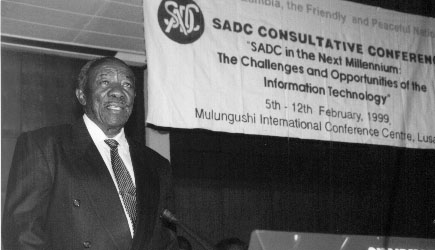
SADC Council of Ministers Chairman and South African
Minister of Foreign Affairs, Alfred Nzo addressing the Council in Lusaka last February.
| One of the
fundamental recommendations of the workshop was the need for a cross-sectional regional
workshop that can put together a comprehensive, SADC-wide response to the secretariat in
Gaborone, Botswana, as well as the committee of ambassadors in Brussels. The regional
workshop is expected to be held by mid-year.
For a region to qualify for a REPA, it has to be a
free trade area (FTA). The WTO requires substantial trade liberalisation within the FTA
– more than 90 percent of trade should be liberalised within 10 years with a two-year
grace period.
Another possibility for establishing a regional arrangement is to have a customs union
with a common tariff regime.There can also be consideration under article 24 of the WTO of
an interim arrangement leading to the establishment of a FTA or a customs union.
Through its various sectoral protocols, particularly the Trade Protocol signed in 1996,
SADC’s long-term objective is to establish a fully integrated FTA. However, out of
SADC’s eight sector protocols that have been signed to date, only three have been
ratified by a two-thirds majority required before implementation can begin. Perhaps most
important, the Trade Protocol, the cornerstone of the perceived SADC FTA, has been
ratified by only five countries Botswana, Mauritius, Namibia, Tanzania and Zimbabwe.
The EU has set a deadline for completion of REPAs between 2000 and 2005. It is almost
certain that the SADC Trade Protocol will have been ratified by the required two-thirds
majority by the end of this year.
Furthermore, there is no formal indication or intention by SADC for the establishment
of a common customs union. However, the Southern African Customs Union (SACU) which is
within SADC, is indeed a common customs union. |
| Lobbying for second waiver |
Whether SADC will qualify for a REPA or not, the
region, just like all other ACP countries, still needs the status quo maintained
to allow time for a future with or without Lomé. A WTO waiver is needed for this to
happen.
Currently, Lomé provisions exist under a WTO waiver which expires in February 2000, by
which time a new agreement should be in place.
The EU wants a waiver of no more than five years. In fact the EU wants negotiations on
REPAs to commence in 2000 and the agreements to be sealed by 2005.
On the other hand, the ACP, while recognising that non-reciprocal trade is a short-term
solution, is asking for 10 years as a means of transition.
The challenge for SADC and the rest of the ACP group is to lobby for a longer waiver by
mobilising support from the EU and other sympathisers in the WTO.
The other challenge is also to lobby for the change of rules that govern time frames
for waivers and the establishment of FTAs. After all, WTO rules are not carved in stone.
Information technology to propel SADC into next millenium
Conclusions of impact study
Opportunities and challenges of
information technology
Co-operation between SADC Central Banks
|
|
| Information
technology to propel SADC into next millenium |
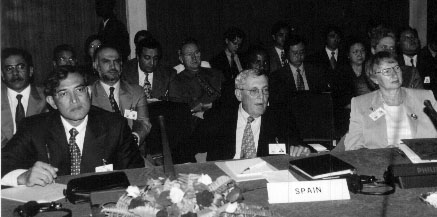
There was a strong presence and participation in the consultative conference by
SADC’s international cooperating partners.
The globalisation of world markets has emerged as one of the greatest challenges facing
developing countries in the last few decades, as they fear marginalisation through unfair
competition. But the information revolution, which came with globalisation, has turned out
to be one of the most irresistible outcomes of the new world order.
Technological advances, especially in the information sector, have dramatically lowered
costs of communication, and countries that moved fast in creating a conducive environment
are now enjoying the multiplier effect of their investments. Realising this, SADC held its
1999 Consultative Conference in the Zambian capital Lusaka on 12 February under the theme:
“SADC in the Next Millennium: Opportunities and Challenges of Information
Technology”.
The conference was attended by government representatives from all the 14 SADC member
states, the organisation’s international cooperating partners and representatives of
the private sector, the labour movement and non-governmental organisations.
The conference was officially opened by Zambian President Frederick Chiluba who
underscored the need for both regional and international cooperation saying it was vital
to “promote transfer of science and technology to developing countries.”
President Chiluba added that “southern Africa cannot fully benefit from the new
information technology if there is no supportive framework for transfer of
technology.”
SADC Executive Secretary, Kaire Mbuende, who also addressed the conference said a new
approach to development was needed for the region to enter the new millennium without
problems such as high child mortality, gender imbalance and poverty.
“We look at information technology, not as an end in itself,” Mbuende said,
adding, “It is a tool that can be used to advance development in all spheres of life
[including] facilitation of trade and investment, education and training which are key to
economic growth and development.”
Uschi Eid, German Federal Deputy Minister for Economic Cooperation and Development
addressed the conference on behalf of the international cooperating partners. She
expressed her government’s willingness to help Africa. She said Germany, which
currently holds the European Union (EU) rotating presidency, was going to launch a debt
relief initiative at the just ended World Economic Summit in Cologne.
Regarding the theme of the conference, Eid said “the march of information and
communication technology into ever more areas of business and society cannot be stopped.
These technologies have become the vehicle and the driving force behind globalisation.
There is not a single country or a single region that is exempt from their impact.
“All must face up to the challenges they information technologies present. They
present opportunities, and these can be drawn on for sustainable development. Yet they
also pose risks, and these risks must be minimised.”
The conference noted that rapid changes had taken place in information and communications
systems ranging from satellite dishes to fibre optics, faxes to Internet – the
fastest-growing consumer service the world has so far experienced. |
“Global information
super-highways have been developed and through them, decisions are now being made quicker
than ever before,” says the conference theme document which was tabled for discussion
by South African Minister of Posts, Telecommunications and Broadcasting, Jay Naidoo, a
firm believer of public-private sector joint ventures in the development of the
communications industry. The impact of communications and information technologies (IT)
is promising to be even more dramatic in the next millenium, says the theme document,
adding: “IT is changing every aspect of human life, communications, trade,
manufacturing, services, culture, entertainment, education, research, national defence and
global security.”
For southern Africa, the advancement of IT is both an opportunity to eradicate poverty,
and a challenge to improve productivity and competitiveness in a world that is fast
becoming one village.
SADC has registered positive economic growth in the last few years, averaging 4.1
percent in 1996 and 2.2 percent in 1997. But these positive growth rates have not been
high enough to have a significant impact on job creation and poverty alleviation, some of
the greatest challenges that are faced not just by the region, but all other developing
countries.
While notable strides have been made in connecting most major urban centres in southern
Africa to the Internet and other ITs, a lot still needs to be done, especially in rural
areas where limited access has often been cited as a major drawback to increased economic
activity in the region.
The Lusaka conference learnt that most countries in southern Africa still rely heavily
on transmitting information through faxes and couriers, despite the fact that most of them
have established communications networks that provide the backbone for Internet-based
communications.
Internet-connectivity in the region is low partly because of low penetration of
personal computers and low tele density.
Available statistics show that there is an average of two computers per hundred people
in SADC, and only five people for every hundred have access to a telephone.
Internet users are estimated at 930,000 in SADC or one user for every 204 inhabitants,
compared to the world average of one user per 40 inhabitants.
With the exception of South Africa, all the other countries have Internet connectivity
concentrated only in the capital city or the second largest urban centre. This has
resulted in the exclusion of citizens in remote areas, and limited economic growth. |
|
|
. |
|