|
W
illiam E.B. Dubois (1868-1963),
a Pan-Africanist and a renowned
African-American
educationist, once prophesied in his
book Black Folk, Then and Now, that
racism or the ‘colour bar’ – a legacy of
colonialism and apartheid — would be
the problem of the century.
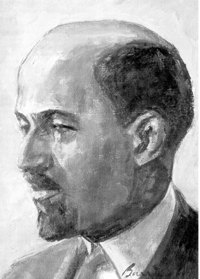
William Edward Burghardt Dubois
Although Africa has by and large
managed to overcome colonialism and
apartheid, an even more difficult legacy
is still manifested in both clear and hidden
forms of racism. The first ever international
conference on racism will soon
be held in Durban, South Africa, a country
that suffered one of the worst forms
of institutionalized racial discrimination
through apartheid. The “World Conference
against Racism, Racial Discrimination,
Xenophobia and Related Intolerance”
is to provide a global setting for a
search for lasting solutions to the problem.
|
The conference will run from 31
August to 7 September.
Mary Robinson, former president of
Ireland now the United Nations Commissioner
for Human Rights said the Durban
meeting should provide “a serious
and honest addressing of the past
realities of racism, discrimination, xenophobia
and intolerance, while also providing
a reinvigorated commitment to address
contemporary scourges.”
Preparations ahead of this historic
conference are intensifying with different
groups and individuals interested in
the subject meeting and presenting issues
to be tabled before the conference.
African ministers, NGOs and churches
have deliberated on the crucial issues of
race and xenophobia and made their recommendations ahead of the conference.
The ministers met in Dakar in January
and passed a declaration on African
regional perspectives on the issue of
racism.The highlight of the declaration
was a proposal for the Durban conference
to discuss reparations to Africa for
the hideous slave trade and colonialism.
The NGOs meeting held in January
in Botswana also reaffirmed the enormous
damages created by enslavement
of the African people from 1400-1900 and
beyond. They equally called for compensatory
measures to be developed and
implemented, coming as forms of reparations.
Perhaps the most complex form of
racism has been discrimination in control
over resources, especially land.
|
In
southern Africa, ownership and access
to land have been a hotly contested issue,
particularly in Zimbabwe and lately
Namibia and other parts of southern Africa
where blacks are battling to gain more
land from white commercial farmers.
Given its growing relevance, the issue
of land redistribution is most likely
to feature prominently during the Durban
conference.
In addition to the different themes of the conference,
the status and discrimination of women and girls, characteristic of
many societies in the world, is also expected to feature prominently.
The conference organizers hope discussing the problem will aid in
legal reforms and a change of attitude to uplift the status of women
and the girl-child.
The protection of minorities and other vulnerable groups
is also expected to be one of the major themes of the conference.
Expectations on the deliberations are to help prevent discrimination
against, and protection of the rights of persons belonging to
national, ethnic and religious minorities.
Among the minority groups are refugees and migrants who
are all over southern Africa as a result of the economic disparities
and the wars in the region.
The conference is expected to be one of the most
expensive gatherings in recent years, with costs estimated to reach
US$11 million. South Africa is expected to provide US$1.2 million as
the host country. But the problem at hand is much
bigger for anyone to worry about the
budget.
|
