|
After defeating colonization and
apartheid, there is yet another
struggle for SADC. This time it is
an end to poverty and achieving economic prosperity.
Yet the majority of its people remain
in the dark, unaware of new corridors of
opportunity at home and across borders, which remain
obscure due
to lack of adequate information.
Most
governments
find people
receiving information
from far-flung
channels that
often focus
on matters
that do not
relate to their
day-to-day
life. Leaders
of the struggle
for independence have been labeled dictators, thieves, villains and monsters,
who have to be removed from office.
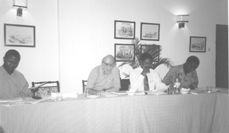
Some of the participants who attended the workshop
in Maputo
The situation has prompted the SADC
committee of ministers responsible for
culture, information
and sport to
decide to end biased
news coverage
by the Western
media.
Dr. Renato
Matusse, co-ordinator
of the SADC
culture, information
and sport sector,
says the region
did not take
globalization seriously
and its components
such as
the information
super highway
when first introduced
in the 1980s. The concepts were
seen as fashions, which would wane and
go with time. But he says like colonization,
globalization “is ruthless, recognizes
no sovereignty, identifies with no ethics,”
and is “a push for control and influence of markets” by the developed
world. SADC only realized this danger
in the 1990s. Through satellite broadcasting and successful
advances in digital technology, Western media had by then reached most
citizens. The effects of cultural erosion and misinformation alarmed
the 14- member group. Something had to be done quickly.
The ministerial committee met in June 1995 in P r e t o r i a , South
Africa, and directed the Secretariat to call for a meeting of editors
of news agencies in SADC. They were to
|
discuss and agree on a
framework for closer collaboration in their various fields.
The editors gathered in November 1996 in Windhoek,
Namibia, where they agreed to set up a regional network that would
respond to this urgent call for better publicity. A task group was
formed, comprising editors of AIM (Mozambique), NAMPA (Namibia), ZANA
(Zambia), ZIANA (Zimbabwe) and the Southern African Broadcasting
Association (SABA NEWS).
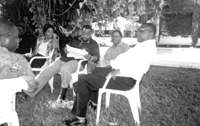
Renato Matusse (centre) of Mozambique leads one of
the working group discussions
It was in March 2001 that this team met again, this time
in Maputo to decide on how the proposed regional news organization
should work. And the Southern African News Agencies Pool (SAN-APOOL)
was born. Delegates to the Maputo meeting recommended a plan by
which national news agencies would release their news to the pool. The
stories would then be collated and sold to user clients. National
agencies would also exchange news through the facility.
The programme called for equipping a regional pool centre,
which has since been provisionally set up under the care of AIM, ahead
of a general assembly still to be decided on.
In order to avoid the problems that hampered similar
initiatives in Africa, the Maputo meeting decided SANAPOOL should
operate on a commercial basis, with a vigorous marketing strategy and
competent staff recruited.
The decision was also made after delegates realized
national news agencies had failed to emphasize their authority due to
lack of funding, a situation that allowed international media to use
their financial muscle to take over more and more ground.
The Maputo meeting agreed that the success of SANAPOOL hinged
|
on its members’ editorial autonomy, and should provide the strength to enable member
agencies to regain their lost territory. While the task would be a
difficult one, delegates decided news agencies in SADC could use the
opportunities offered by Information Technologies, (ITs) to revive
news exchange at the touch of a button. They also agreed to start the
process before their progress report could be considered at this year’s
meeting of the SADC committee of ministers. And the exchange is
already being implemented by AIM, NAMPA, SABA NEWS, ZANA and ZIANA.
The taskforce has also asked the SADC Secretariat to make
news material available regularly and on time. What now remains is
political commitment by governments, which should provide necessary
resources and an enabling environment.
SANAPOOL also aims to support and expand in-service
training in news agency journalism and management, and improve the
technical capabilities of news agencies in southern Africa.
It is expected to have all news agencies in the region as
members, with its organs comprising a General Assembly, an Executive
Committee and a Secretariat. The General Assembly will meet each
year.
SANAPOOL, in its mission statement, has pledged to
collect, collate and disseminate news about and to the SADC region and
to foreign nations through collaborative efforts of its member
agencies, and build a comprehensive database.
In the same line, to ensure quality reports, the Sector
is to launch the SADC Media Award, which is expected to commence next
year. Contestants would be expected to submit entries in the form of
audio-visual and print, focusing on regional integration.
Political and economic commentators, as well as other
experts in different fields, have commended the formation of SANAPOOL as an effective
way to end poverty and correct the
often distorted regional image.
|
