|
Zambians go to the polls this year
to choose a president and 150
elective members of parliament.
The vagaries of the campaigns and the
results will certainly attract the attention
of its 13 SADC neighbours in a region
where recent elections have been widely
accepted as free and fair.
Unlike previous elections, voters will
choose a president and members of parliament
from a wide variety of parties that
includes the ruling Movement for Multi
Party Democracy (MMD), the United
National Independence party (UNIP), the
newly formed Forum for Democracy and
Development (FDD) and several other
opposition parties.
As elections draw closer, internal
problems have beset the ruling party
stemming from differences over a controversial
push for President Frederick
Chiluba, contrary to the constitution, to
run for a third term. The divisions
brought on unprecedented open dissent
by more than 60 MPs, among them serving
senior cabinet ministers and 10 deputy
ministers.
President Chiluba finally stated firmly
that he would not seek a third term
and seemed to put an end to the debate
which threatened violence among citizens.
But he first fired 22 of his ministers,
including Vice-President Christon
Tembo, and the legal affairs minister. The
president then constituted a new cabinet
which analysts said was made up of
politicians whose images were largely
untainted by the third term controversy.
While President Chiluba was busy
suturing together the MMD, the opposition
took full advantage of the political
ruckus and convinced people the ruling
party was no longer a viable movement.
The 22 expelled MPs and ministers
teamed up to form the FDD which has
attracted prominent ex-politicians and
civic leaders. However, while the split in the MMD
has given its opponents cannon fodder,
the opposition cannot really be certain
of victory. |
For a start they are in competition
with each other and do not seem interested
in coalition politics which would
curtail vote-splitting.
Of the 24 registered parties, only
three are of any note. The most promising
is the United Party for National Development
(UPND) which is being decampaigned
as a tribal party because its
leader hails from the southern province. Southerners, who
say their clansmen
have been marginalized
in the current
government, are
agitating for a president
from their own
neck of the woods.
Conscious of these
sentiments, its leader,
Anderson Mazoka,
has included
people from the
other eight provinces
in the executive
committee.
UNIP, the
former ruling party,
now without its
founding leader
former President
Kenneth Kaunda, is
a shell of what it
once was. It has fallen
on hard times both financially and in
leadership quality. Currently at the helm
is Kaunda’s fourth son Tilyenji, a political
novice who lives in Zimbabwe and
has very little support among the party
stalwarts. His family name and a leadership
vacuum, rather than ability or popularity,
are what have propelled him to
the top. UNIP does not stand much of a
chance in the presidential elections but
still has support at grassroots levels for
its parliamentary candidates.
Further afield, the Zambia Republic
Party (ZRP) is a new entity, headed by a
former MMD defence minister and Chiluba’s
uncle, Benjamin Mwila. Chiluba
sacked him from the cabinet a year ago,
ostensibly for openly opposing his leadership.
The party is a merger of the tottering
Zambia Alliance Party (ZAP) and
the National Lima Party. Having been in government, Mwila, a wealthy businessman,
finds it difficult to absolve himself
of any wrong the current government
may be accused of today. While he has a
strong following in the country’s Northern
province, he is having some difficulty,
analysts say, convincing people that
he can deliver.
|
Zambians seem wary about whom to
vote for. Some are resigned to voting in the MMD again, no matter
who leads the party,
because there have seen
improvements in their
lives since the party
swept the polls in 1991.
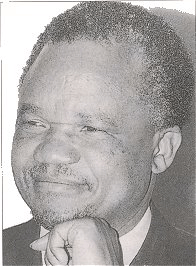
President Frederick Chiluba
“We don’t have to
queue for essentials any
more, we have new
buildings, there is food
in the shops,” said one
marketeer.
But Zambia Independent
Monitoring
Team leader Alfred Zulu
after visiting rural areas
said he was nervous that
people would not vote
because of the political
system’s failure to yield
results.
“People are indifferent
because they feel
that their elected representatives
never do anything to change
their lives.” He says there is a lot of work
to be done to encourage people to vote.
Director of Women for Change, Emily
Joy Sikawe said people need to be
taught how to make their representatives
more accountable. “If people feel that
elections do not make a difference in
their lives, of course they should not be
forced to vote. Teach them how to lobby
and agitate for change, then they will
give their votes.”
She says even the concept of choosing
MPs from different political parties
is new to many. “People must be made
aware that they can choose the people
they want from various parties, not just
one, and then leave it up to the president
to form his coalition government, if
that is what is necessary.” |
