|
African leaders have buried the 38-
year old Organization of African
Unity (OAU) with honours at
July’s Summit in Lusaka, which has seen
the birth of a transformed, stronger African
Union (AU), modelled along the lines
of other regional groupings in the Americas,
Asia and Europe.
The summit elected former Ivorian
Foreign Minister Amara Essy as the new
secretary-general, replacing Tanzanian
Salim Ahmed Salim whose third term as
head of the OAU effectively ends in September.
Zambian President Frederick
Chiluba takes over as the new chair of
the AU until the next summit. OAU headquarters
will remain in Addis Ababa.
In a bid to achieve economic development
and move the continent into the
mainstream of global economics, the
summit merged the South African-led
Millennium Africa Recovery Plan (MAP)
with Senegal’s proposal, code-named
Omega, into one blueprint called “A New
African Initiative”.
“These are initiatives intended to
forge Africa ahead in its socio-economic
recovery,” said Chiluba who added
that the important decisions made needed
to be implemented without delay.
“Africa does not have the luxury of
time. We are living in an era where
change takes place… in milliseconds,”
he said.
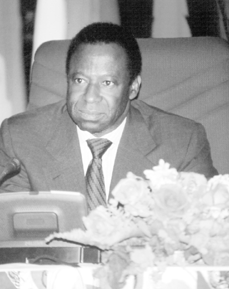
Incoming Secretary-general, Amara Essy
The AU will provide a more powerful
executive council, an elected parliament
and, perhaps more importantly, an African
central bank, a court of justice and
concrete institutions which should ensure
that the often touted African economic
community, finally takes hold.
The Lagos Plan of Action of 1980,
and the subsequent Abuja Treaty of
1991, envisaged the creation of an African
Economic Community, built on existing
and emerging regional trading
blocs such as SADC, the Economic Community
of West African States (ECOW-AS)
and the Common Market of East and
Southern Africa (COMESA).
Despite the obvious optimism in Lusaka,
the creation of the AU faces a long
road to successful implementation. The
proposed parliament may be weak initially, but the fact that it will be voted in
by national legislatures will present an
element of representation the OAU never
had. The strength of this continental
parliament will come from the pressure
of increasingly vocal African NGOs and
civil societies. There is much enthusiasm and excitement
about the new treaty but
|
there have
been some misgivings – many were wary
that Libyan leader Muammar Gaddafi, the
initiator and main funder of the AU, will
try to be an overly-dominant force. Gaddafi
is alleged to be looking for new allies
since his failed Pan-Arabist bid some
years ago and, said some delegates at
the final meeting of the OAU, the speed at which he was pushing African unity
raises this suspicion.
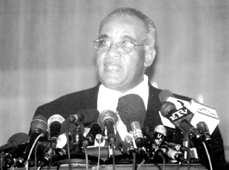
Outgoing Secretary-general, Salim Ahmed
Others were skeptical
that African countries would fail
to agree to economic
and political convergence,
giving
examples of current
economic groupings,
which have a
difficult history of
economic harmonization.
Then there is the
more common argument
that the problems
which dogged
the OAU would
simply be transferred
to the AU.
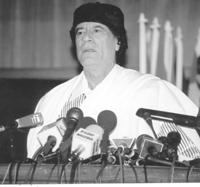
Libyan leader Colonel Muammar Gaddafi is the
initiator and main funder of the African Union
Outgoing OAU Secretary-General
Salim thinks not. Trying hard to downplay
his sense of frustration at member
... the AU would facilitate
stronger regional groupings.
It will provide a more aggressive
lobbying and advocacy
platform carrying the voice of
the entire continent.
states’ apparent indifference to the OAU
during his tenure, he said in Lusaka that
if the OAU had simply faded away, it
would have been a sad ending. Salim said
that like the failed League of Nations
which was set up after World War I, and
was replaced by the United Nations after
World war II, so the OAU needed “to
be updated.”
The OAU was founded in 1963, to
become the most comprehensive of all
the political organizations in Africa. It
was the result of independent founding
fathers putting their Pan- Africanist ideas
into reality. It had the double goal of
successfully finishing the liberation
struggles and uniting Africa. It was successful
in the anti colonial struggles but
constantly battled
with its unification
agenda. According to
Dr. Tajudeen Abdul
Raheem, secretary-
general of
the Pan-African
Movement in
Uganda, there
were many reasons
for these
problems. Firstly
the charter was a
compromise between
the desires
of the radical Casablanca
states led
by the late presidents
Kwame Nkrumah
of Ghana
and Gamel Abdul
Nasser of Egypt (both of whom wanted an immediate continental
political union) , and the
|
moderate,
conservative alliance represented by
the Monrovia and Libreville group of
states, who found a credible spokesperson
in the late Tanzanian leader, Julius
Nyerere.
Although Nyerere was not a conservative,
he was opposed to Nkrumah’s fast track policy and instead
argued for “func-tional
unity” – economic
unity before political
union.
Another restriction
on the OAU was the inviolable
edict that colo-nial
borders needed to
be absolutely respected
because of the fear of inter-
state wars. This policy
tied the OAU’s
hands and actually
caused it to appear a
casual observer of African
conflicts.
The UN did not have such inhibitions
and made an issue of peacekeeping –
albeit often concentrating its efforts on
western conflicts. Ironically, African
countries themselves responded timely and overwhelmingly to UN demands to
instil peace in countries outside Africa.
The Cold War and the emergence of
neo-colonialism also limited the OAU’s
room for manoeuvre. What mattered then
was whether regimes were pro-East or
pro-West, not their Pan- Africanist credentials.
Many of these issues have
since fallen away and there is a lot more
optimism that the AU will pick up where
the OAU has left off, but whether its
powers and functions will surpass those
of the OAU remains to be seen.
Kenyan President Daniel Arap Moi
said defining the authority of the AU and
absorbing all its regional groupings had
to be handled delicately to avoid unnecessary
confusion and rendering the AU
“useless”.
Moi told delegates to the COMESA
Free Trade Area launch in October 2000
that the AU should draw lessons from
older organizations like the EU and apply
their experiences to avoid the same
pitfalls. “The pace of globalization will
not wait for Africa, we need to gallop
ahead,” he said.
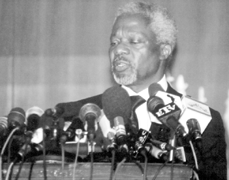
UN Secretary-general Kofi Annan Delivers a speech at
the Lusaka Summit
His words resonated with Erastus
Mwencha, COMESA chief Executive,
who said the AU would facilitate stronger
regional groupings. “It will provide a
more aggressive lobbying and advocacy
platform carrying the
voice of the entire continent,”
he told journalists
recently. Mwencha
sees a great boom in
trade between countries
and dissolution of red
tape in immigration and
trade laws.
He said economic
integration and co-operation
would become
more of a reality because
“what is needed is to
pull the continent out of
its quagmire.
“Not that Salim was doing a bad job
at the OAU, he did well given the limitations
of member States, but I think our
focus has changed and we need a fresh
impetus to get Africa into the economic
powerhouse it can become.” |
