|
The sluggish DRC peace process
received a psychological and practical
shot in the arm in July when
Belgium assumed the six-month presidency
of the European Union and
pledged to put the DRC at the top of its
agenda.
Prime Minister Guy Verhofstadt returned
to Brussels to assume the presidency
just hours after completing a trip
to Kinshasa and Kisangani in Belgium’s
former Congolese colony.
Comparing the level of commitment
of the European nations to peace in the
Balkans with that of Congo, Verhofstadt
said there was no comparison between
the two regions where the EU allies have
40,000 troops in Kosovo and just under
2,000 in DRC, attempting to bring peace
and democracy to Africa’s third largest
country which has been devastated by
civil war for almost three years.
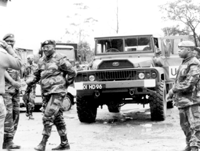
SADC allies have pledged complete troop withdrawal
once the UN is sufficiently strong to ensure that peace can hold in
the DRC
Two international surveys agree that
at least 2.5 million people, mostly civilians,
have died in the 32 months since
war broke out in August 1998 between
invaders from Uganda and Rwanda,
rebels, Congolese forces and their backers,
Angola, Namibia and Zimbabwe. The
instability and displacement, especially
in the eastern DRC, have caused disease
and malnutrition in which more people
have died than all other wars combined
over the same period says the New York-based
International Rescue Committee(IRC) which described the situation as
“horrific.” While Ugandan troops are pulling
out under minimal UN supervision and
Rwandan soldiers are mostly back home,
a tangled web of rebel alliances related
to Rwanda and Uganda still cannot come
to any agreement despite the UN Mission
to the Congo’s (MUNOC) best efforts.
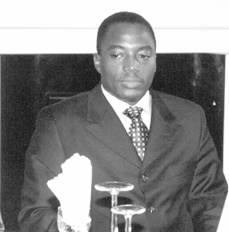
President Joseph Kabila, DRC
Meanwhile the SADC allies have
submitted
|
their plans for withdrawal to
the UN according to the 1999 Lusaka
Peace Accords, but feel they cannot implement
them until the UN is sufficiently
strong to ensure that peace can hold.
Originally the UN promised 5,537 military
observers of whom 1,915 have been
deployed in a country where there are six-month agenda
almost no functioning roads, communications,
and other infrastructure.
The political committee on the implementation
of the Lusaka Accords has
made it clear that the majority of the
SADC soldiers cannot be sent home
“until the UN takes its role seriously.”
Where the UN has failed, the EU may
provide the necessary weight to bring
about peace and tranquillity within the
chaos that is in Congo today. With Belgium
in the powerful agenda-setting seat
for the rest of the year, Verhofstadt has
a mandate to propose solution to improve
the situation in central Africa, the
DRC and the Great Lakes region.
“I want to draw attention to the development
of a coordinated action – political,
diplomatic and economic – for this
region,” the prime minister said. “The
Balkans and Middle East are important
but when it comes to human suffering,
no comparisons can be made.”
He agreed with most African analysts
that the three years of war in DRC
constitute Africa’s first continental war
with “enormous consequences for those
who live there.”
The Security Council promised, in
addition to the 5,500 military observers,
a peace-keeping force of yet-to-be determined
size. Military analysts point out
that tiny Sierra Leone has 17,000 UN
troops for its diamond-fuelled civil war
while Congo, which is 20 times its size
and is called the “cradle of the world’s
mineral resources”, does not even know
the size of the peacekeeping army. African
diplomats say the UN should be able
to at least match Sierra Leone’s 15-18,000
troops but that western powers favour
something about half that size
The human tragedy, which had such
an impact on Verhofstadt, has reached
apocalyptic dimensions which seem to
have failed to get the attention of the
western governments, preoccupied with
the Palestine-Israel and Balkan conflicts.
American, British, EU and NATO forces
and high-tech equipment are based in
former Yugoslavia to try and keep the
peace while the non-stop shuttle-diplomacy
between Israel and Palestine occupies
much of world media’s attention.
In contrast the extent of Congo’s
|
humanitarian disaster is revealed in all
its agony as the invading armies pull outand the aid agencies move in. While, say
IRC, some 350,000 people died as a direct
result of the internecine fighting, about
2.2 million have died from the results of
war–starvation, disease and deprivation.
For much of the war, little was known
about the human toll of a war fought
largely out of the world’s sight. When
the first IRC “death census” began to
emerge, President Joseph Kabila called
it evidence “that this stupid war verges
on genocide.”
IRC conducted two surveys, one in
the rebel-held eastern part of the country
and another further away from the
worst fighting. Both revealed extremely
high mortality rates among adults and
extraordinary death rates among children.
“Mortality rates this high are com-mon
in humanitarian emergencies whichusually last only a few months because
intervention takes place and some stability
is introduced,” says the IRC
report.
In DRC, the hugely elevated rates of
death have continued for 32 months,
across a vast region rendered inaccessible
to aid because of fighting and lack of
roads.
Children in particular are dying at an
“unbelievable rate”. Around Lake Tanganyika’s
western shore almost half the
infants were dying before reaching their
first birthday. Around Kalima in Maniema
province, British medical aid workers
documented that two-and-a-half times
more deaths than births had occurred
among a population that before the war
was growing at three percent a year. IRC
estimates that wartime deaths are also
high because people were afraid to live
in their homes and left instead to live in the dense bush and jungle where help
has been impossible.
Aid has been slow in coming any-way.
A January appeal from the World
Food Programme to more than double
its DRC food aid to US$110 million has
been barely one-third funded by rich
western countries. UNICEF has received
just a 10th of the US$15 million needed
for essential drugs and therapeutic feeding centres.
Despite vows of action from Washington
that greeted IRC’s first survey,
U.S. disaster relief to DRC remains at just
US$13 million, a sum already exhausted.
Ironically, as this story was being
prepared, the rich western nations
pledged US$1.6 billion in assistance to
Serbia to rebuild following the NATO-led
bombing of Serbia. The price was to
send former president Slobodan Milosovec
to trial at The Hague. |
