|
As the HIV/AIDS scourge continues
to cause havoc within southern Africa, voices are growing for
serious consideration of a cultural approach
to the prevention and awareness
of the infection. UNAIDS, in conjunction
with UNESCO, organized an international
conference on the cultural approach to
HIV/AIDS prevention and care.
The conference held in Nairobi, urged
the world to approach the disease from a
cultural perspective as well as medical. The conference put forward a
methodological handbook with
guidelines and strategies.
A cultural approach to HIV/
AIDS entails tackling the problem
from a position of values,
norms, traditions and other cultural
institutions as platforms to
discuss and communicate
about the virus and the disease.
This approach hopes to entrench
every action of tradition,
beliefs and value systems for
ethical and practical reasons. It
also mobilizes cultural resources including, knowledge, modes
of economic and social organization
and creativity and self-confidence.
Sub-Saharan Africa carries the greatest burden of the disease, with
more than 23.3 million people already affected,
representing 70 percent of the global
infections. UNAIDS estimates of 1999
indicate that Botswana has a staggering
infection rate of 35.5 percent followed by
Swaziland with 25.25 percent, Zimbabwe
25.06
|
percent, Zambia 19.95 percent, South Africa 19.94 percent and Namibia
with 19.54.
The increase in the pandemic has been linked to
the breakdown of family patterns, gender, relations,
traditions, moral values and behavioural patterns, caused by
a shift of people from rural to urban environments.
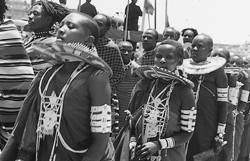
Cultural practices that discourage premarital sex need to be encouraged
Cultural practices singled out as contributors
to the pandemic include male
circumcision, female genital mutilation,
cosmetic tattooing or administration of
charms, widow inheritance and death cleansing.
Sexual practises and behaviour are
culturally imposed in some societies. An
individual’s concept and expression of
sexuality is deeply entwined in the social
norms of the community.
In Swaziland, the multiplicity of sexual
partners for men is supported by
Swazi culture. A man who engages in multiple sexual encounters is called Ingwanwa
which is positive, and widely
accepted. The female equivalent is the
Ingwandla a derogatory term.
Widow inheritance, still prevalent in
some southern African countries, entails
the younger brother or a relative of
the deceased husband “remarrying” the
surviving woman. It is also widely believed
that if this is not observed the
spirit of the dead man will be visiting
those living to make demands.
|
The practise is innocent as it aims at
providing means and support for the widow and her
children in the absence
of her husband.
However, now this
practice encourages
the spread of the
pandemic.
In countries like
South Africa, Swaziland,
and Zimbabwe
pervasive polygamy is
practised in some areas.
This involves parents
giving away their
innocent young
daughters in marriage
to older men with several
wives for monetary
gains. Transactions of
this nature happen without the girl’s knowledge and consent.
Early marriages and early sex of
this nature expose young girls to high
risks of contracting HIV/AIDS, especially
where multiple partners are involved.
Nevertheless not all cultural practises
and institutions contribute to the rise
of the epidemic. The use of initiation
ceremonies for men and women aimed
at discussing sexuality and sexual activities
can be used to communicate is-sues
related to HIV/AIDS. Originally
such forums would teach girls what
womanhood is about. To the boys the
forum teaches them aspects of manhood.
Virginity is still practised in the region.
It encourages girls and boys not
to engage in sex at a tender age. In Swaziland
the ‘Reed Dance for Maidens’ has
supported and maintained virginity and
abstinence. While a ceremony of picking
Lusekwana (the holy tree) serves a
similar purpose for boys.
|
