|
Foreign direct investment (FDI) is
regarded in contemporary econom
ics as the universal remedy to under-
development. Some analysts are
however, asking whether this assertion
has been proven anywhere in the world?
For many, it has become taboo to
question the efficacy of laissez faire economics,
and therefore the role of FDI,
much as President Thabo Mbeki’s divergent
views on AIDS earned him the dissident
label. But just as Mbeki challenged
medical experts to explain the link between
AIDS and poverty, neo-liberal
economists should explain the link between
rising poverty and FDI in recipient
countries.
A snap survey of the impact of FDI
in the southern Africa region raises more
questions than answers. Zambia for instance,
which was pressured by the
World Bank and International Monetary
Fund (IMF) to privatize its parastatals
has incurred huge losses. Large copper
mines were sold for a song, mainly to
foreign-owned companies. Zambia today
feels cheated.
A regional seminar, bringing together
representatives of NGOs and trade
unions which was recently held in Windhoek,
Namibia, criticized the emphasis
SADC governments are placing on FDI
as a tool for economic development.
Participants pointed out that “SADC
governments are trying very hard to create
the ‘right climate’ for investment on
the advice of so-called experts from the
World Bank and IMF”.
“However, governments are not
putting the right policies in place to ensure
that such investments serve a national
development agenda,” reads a
statement produced after the seminar.
The statement says governments often
engage in a ‘race to the bottom’ as
they compete with one another to attract
FDI by lowering corporate taxes, relaxing
environment and labour standards,
and allowing repatriation of profits, something
that in many instances has worked
in reverse. In 1993, Zimbabwe gave Australian mining giant Broken
Hills Properties (BHP) major incentives when the company
moved in to mine platinum in what was then touted as
the
|
biggest mining venture in the
country. Among other incentives, the company was granted a
five-year tax holiday, 100 percent profit repatriation,
relaxed labour laws and was the only mining company that was
allowed to export directly without going through the
Zimbabwe Minerals Marketing Corporation.
What did Zimbabwe get in return? After about
five years of mineral exploitation, the platinum mining
company pulled out citing viability problems, leaving
hundreds of workers out of jobs.
As in the case of Zambia, South Africa
privatized water provision in some of its municipalities.
Profit-hungry transnational corporations that bought the
rights to provide water hiked tariffs, resulting in many
low-income families failing to access clean water. This move
was blamed for the recent cholera outbreak in the country.
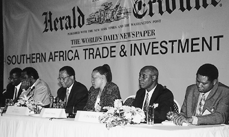
Too much has been placed on transitional
at the expense of indigenous entrepreneurs
Against this background, the seminar concluded
that southern African governments should set minimum
requirements for foreign investors that stipulate that they
cannot invest in certain sectors and that they cannot
undermine the rights of workers and women or damage the
environment.
“They (governments) should look at ways of
ensuring that foreign investors develop the local economy,
spread technology to local companies, and employ and
transfer skills to local workers and managers.”
But do developing countries really need every form of FDI?
For southern Africa, as the rest of the developing world,
pressure is intense to conform to the tenets of the World
Trade Organization (WTO), an institution that came out of
Uruguay Agreements from which developing countries were
excluded. Thus to explain the role of FDI,
it is important to first understand global dynamics. The
global economy is, on one hand, a battle
|
for power interests that is among
peoples, social classes and nations as they scramble to
control the world’s resources. On the other hand it is a
battle for emancipation from poverty and exploitation.
It is equally important to mention that
development policies, as propounded by the West, originate
from theories that are defined in Western universities and
often blindly replicated in institutions of higher learning
in the South.
“This is done through peer group
certification of knowledge that is admissible in scientific
discourse and publishable in books and journals that carry
mainstream ideas that support the ‘real’ ie material
processes of globalization and centralization of capital,”
says Prof Yash Tandon, a Harare-based anti-globalization
activist.
He says any expression of thought that is
contrary to this dominant paradigm, or that supports a
liberation process is quickly dismissed as “going back to
the old days of outdated and defeated Soviet thought”.
“By this dual process of reaffirmation of the
dominant paradigm and the rejection of the liberatory
theories, the process of centralization of capital proceeds
unabated,” he adds.
FDIs are another form of capital, often
referred to as factors of production ie land and other
natural resources, labour, machinery, management and
technology. So it is the control over these that big powers
seek to protect.
Thus transnational corporations, which bring
FDI, seek to maximize profitability by lowering cost of
production through means such as depressing wages, bringing
into production cheaper resources and conquering new
markets.
It comes as no surprise that the WTO, which is
controlled by the rich nations, is advocating for laissez
faire, ie removal of state hand from the market. The logic
is simple, the state interferes with the trans-nationals’
quest to control the resources and conquer markets.
So when institutions such as the Bank, IMF and
WTO — which are answerable to the big powers of world
economy and their multinationals – say
Africa needs foreign direct investment,
in whose interest do they say this?
|
