|
In a
humiliating back down, 39 of the
world’s pharmaceutical companies
dropped their lawsuits against South
Africa, which will allow Pretoria to buy
anti-AIDS medicines at generic drug
prices.
The ramifications go far beyond
South Africa’s borders and the cheap
treatments needed for people with HIV/
AIDS. By withdrawing their objections
to South African legislation in the face
of enormous international pressures and
adverse publicity, the way is now open
for other southern African countries to
enact similar laws.
The case has also focused on the
issue of patent rights and highlighted
the concerns of many NGOs, churches
and governments that international trade agreements are seriously skewed
in favour of the developed world.
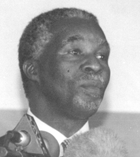
South Africa's President Thabo Mbeki
One of the most serious myths exploded
by the dismissal of the case and
a matter of great importance in the future,
is that major transnational corporations are impervious to unified social
pressure even when governments
|
are
themselves afraid to respond to people’s
demands because of the sanctions which
can be imposed unilaterally or by the
World Trade Organization (WTO).
Not only has South Africa scored a
major victory in the struggle against its
burgeoning HIV/AIDS pandemic, but the
powerful and secretive pharmaceutical
industry, in an effort to counteract their
bad publicity, has struck a deal with the
European Union that will allow millions
more people each year to be saved from
death from preventable diseases such as
tuberculosis, pneumonia and malaria
which kill 10 million people-a-year.
When the withdrawal of the court
action by the Pharmaceutical Manufacturers
Association (PMA) was announced in late April, the Pretoria courtroom
erupted as lawyers, government
officials and activists cheered the decision
to withdraw the action to have the
Medical Schemes Control Amendment
Act declared unconstitutional.
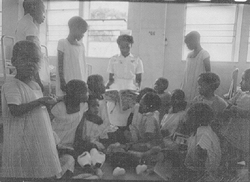
Cheaper drugs will save the lives of thousands of HIV infected
children in southern Africa
Even while South Africa was elated
by the dismissal, it was well aware that
the health issue is squarely in their jurisdiction
because the government now has
the tools to implement major improvements
in the health care system, especially
for people living with HIV/AIDS.
|
South Africa will be Red ribbon
able to shop around for
generic antiretroviral
drugs especially in Thailand,
India and Brazil
where they are available at
much lower prices but the
unanswered question is
when will the drugs become
available in a country
where more than 5,000
people are dying every
week of AIDS?
The drug industry
says ending the court action
will not affect their
offers for the free and reduced
drugs they have ribbon
offered developing countries and that
they intend to work more closely with
governments and civil society to help
the poor get access to medicines.
But access is a battle yet to be won.
The Treatment Action Campaign (TAC)
which coordinated much of the awareness
campaign around the court case,
says that fight, first at home and in southern
Africa, and then tying into international
aid agencies will continue.
Activists point out that as long ago
as l928 when penicillin, the first modern
wonder drug, was invented it was never
patented because it was considered
such a great benefit to the whole world
that no one should have a monopoly on
its manufacture.
Today’s drugs industry takes a diametrically
opposite view claiming that
protection of intellectual property takes
precedence, even if it means that poor
countries in Africa cannot manufacture
or buy cheap copies of drugs they urgently
need.
|
