|
Heads of State of the Southern
African Development Community
have approved a radical restructuring
of SADC institutions to
“squarely face the daunting regional
and global challenges”.
Consultations over the past year at
ministerial level proposed the restructuring
and centralization of SADC functions,
from 21 sectors based in 12 countries
and dealing with a diverse range of
development issues from health, environment
and mining to trade, tourism
and investment into four clusters to be
located at the SADC headquarters in Gaborone,
Botswana.
The proposal was adopted by Heads
of State with little change, setting SADC
on course to streamline itself rapidly into
four Directorates, as follows: Trade, Industry,
Finance and Investment; Infra-structure
and Services; Food, Agriculture
and Natural Resources (FANR); Social
and Human Development and Special Programmes.
These changes are to
be implemented over
the next two years, beginning
with the trade,
industry, finance and
investment directorate
to be established by
August this year, and
FANR Directorate by
year-end.
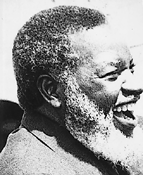
President Sam Nujoma
The SADC Chairperson,
President Sam
Nujoma of Namibia, said the restructuring exercise will be
tested against results in terms of “greater
unity, increased and meaningful economic
integration as well as economic
competitiveness in the global market
place. These will be the yardsticks that
will measure our successes or failures.”
The summit also agreed to create the
Department of Strategic Planning, Gender
and Development and Policy Harmonization, to strengthen the Secretariat
in executing these functions and to
serve as a think tank for community building,
regional integration and
development.
Functions of the Council of Ministers
remain as
|
outlined in the Windhoek Treaty of 1992,
but Summit also established
an Integrated Committee of Ministers
to oversee activities of the core
areas of integration, including implementation
of a Regional Indicative Strategic
Development Plan.
The Summit agreed that its own functions
will remain as outlined in the Treaty
and that the Troika system must be
“formalized and provided for in the Treaty.”
This system is already operating in
practice and facilitates consultation and
leadership by the present, past and next
SADC Chairpersons, currently Presidents
Sam Nujoma of Namibia, Joaquim
Chissano of Mozambique and Bakili
Muluzi of Malawi.
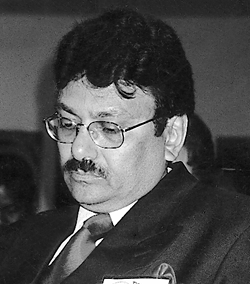
Prega Ramsamy
Another item settled for public consumption
after some backroom bargaining
was the status of the SADC Organ
on Politics, Defense and Security,
launched at an Extraordinary Summit in
Botswana on 28 June 1996, as a separate
consultative structure to “allow more flexibility
and timely response, at the highest
level, to sensitive and potentially explosive
situations.”
As such, the Organ took over the
security mandate of the old Front Line
States (FLS) grouping established in the
1970s to deal with political and security
issues associated with support for the
liberation struggle in southern Africa. It consults at summit, ministerial and technical
levels, the most active component
being the Inter-State Defence and Security
Committee (ISDSC).
SADC leaders agreed at their annual
summit in Lesotho, a few months after
launching the Organ, that it “would become
the foremost institution of SADC
mandated to address issues relating to
political stability, conflict management
and resolution, democracy
and human
rights, as well as issues
|
pertaining to peace.” The Organ has been
administered by the
Ministry of Foreign Affairs
of Zimbabwe since
its inception, and headed
by President Robert
Mugabe, who was elected
by his colleagues at
the inaugural summit.
There has been a reluctance by a number of member states to begin the rotation of
leadership before formal agreement on
the mandate and functions of the Organ,
after disagreement over whether it
should become an integral part of the
SADC structure.
The Organ “will now be integrated in
the SADC structures” but coordinated
at Summit level on a Troika basis reporting
to the Chairperson of Summit. Leadership
of the Organ will begin to rotate later this year as previously agreed, when
SADC leaders meet in Malawi for their
annual summit. The structure, operations
and functions of the Organ will be regulated
by a new Protocol on Politics, Defence
and Security Cooperation.
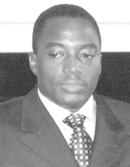
President Joseph Kabila, DRC
The Summit appointed Prega Ramsamy
to the post of Executive Secretary
of SADC, beating four other candidates.The former Chief Economist
and Deputy, Ramsamy
has been acting
Executive Secretary
since Kaire Mbuende’s
departure in August
1999. An economist
from Mauritius with
some 19 years experience
in the field, Ramsamy
is a technocrat focused
firmly on trade.
The face that attracted
the most interest as
SADC leaders lined up for their photo call at this Extraordinary
Summit was also the newest and youngest,
that of General Joseph Kabila, the
29-year-old son of assassinated DRC
leader, Laurent Kabila.
Well-turned-out in a natty, wide-la-pelled
suit, Kabila the younger was a dignified
presence both on the platform and
off, during a moment of silence in remembrance
of his father and during top-level
bilateral meetings about the future of his
country.
|
