|
The search for solutions to end the
crushing debt problem in developing countries has reached a new pitch as NGOs embark on a
campaign to lobby governments to form “debt cartels” as a way of strengthening their
negotiating power with northern creditors.
Civil society, fed up with the evasive and
contradictory efforts of rich countries in their handling of the debt
crisis, say their past efforts to persuade creditor countries and
institutions to extend debt relief have at best been manipulated, and at worst completely
ignored. Instead of
complete write-offs, which are crucial to releasing vital resources towards essential services such
as health and education, developed countries have often only managed to reschedule
(defer) the debt.
“Arrogant!” is how
activists have described the behaviour of northern governments and the international financial
institutions — led by the World Bank and the International Monetary Fund –
in which they are majority shareholders.
Activists have for the past decade advocated debt cancellation, a solution
that creditors have some control over. Now the creditors risk outright
repudiation, that is, a unilateral termination of debt repayments by the South.
In 1997, South Africa cancelled the
debt that it was owed by Namibia. Many rich countries have taken similar action
but usually on a piece-meal basis.
Evidence suggests efforts to solve third world debt problems have so far
not been sufficient, prompting civil society groups to call on affected
countries to “stop paying now”.
Debt-related figures in poor countries are shocking. The UN estimates
that 19,000 children die each day as a result of the social impact of debt.
Millions of women and men are dying every year of preventable diseases, lack of
clean water and sanitation – and millions of children are not in school, two-thirds
of them girls.
And yet the G8 industrialized countries,
which are due to hold their annual summit in Italy in July, hope to cut by
half the number of people living in absolute poverty only by 2015.
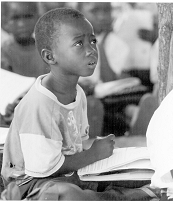
Hoping for a debt-free future
“For every dollar that rich countries
lend to developing countries $8 comes straight back in the form of repayment
on debts owed to the rich countries,” says Anglican Archbishop Njongokulu
Ndungane of Cape Town, successor to the world-revered and now retired
Desmond Tutu, who is championing the fight against apartheid-caused debt in South
Africa.
“So wealth is not trickling down from
the rich to the poor, as people |
like to think. Wealth is actually pouring from
the South to the North,” he says in a paper published by
Debtchannel.org.
Countries of the South find them-selves
giving away, virtually for nothing, earnings from their precious commodities like coffee, copper, tea and
sugar. This is a form of economics that denies the world humanity, rich and poor
alike, says Ndungane, who is also one of South Africa’s great Robben Island
legends. (He served three years of hard labour on the notorious island as a
political prisoner.)
The Bank and the Fund’s much
publicised Highly Indebted Poor Countries (HIPC) initiative, which the two
institutions claim is helping to spring poor countries out of the debt trap, has been
criticised its many inadequacies. To qualify for this scheme, countries have to
fulfill strict conditions designed to restructure the economy, many of which have a
negative impact on the poorest people.
In Mozambique, one of the first
“beneficiaries” of the 1996 HIPC scheme, the government was forced to open up its
cashew nut industry and begin sending raw nuts abroad for processing instead
of processing them locally, as part of the conditions qualify for debt relief. Today,
the cashew nuts are fetching a lower price on the international market, while
more and more Mozambicans are losing their jobs.
And to make matters worse, the debt relief plan will save Mozambique
precisely US$10 million-a-year out of a debt burden estimated at US$5.5 billion – and this
after the intervention of civil society which exposed many irregularities in the
original plan. It could have been worse. To service the remainder will still cost
Mozambique twice what it is able to spend on health care.
So far 22 of the 41 HIPC countries have “benefited” from the scheme, four
of them from the region – Malawi, Mozambique, Tanzania and Zambia. But the
22 countries will still have to pay $2 billion-a-year to rich creditors, leaving the
majority still spending far more on debt repayment than on than education and
health.
Zambia, which was granted debt relief in December 2000, will still be paying
US$170 million out of its annual budget of US$800 million.
JubileePlus – one of the official
successor organisations to the highly successful anti-debt repayment Jubilee 2000
— says that in 2001-2005, Zambia will be paying substantially more to the IMF and
World Bank than other creditors under the “enhanced” HIPC debt deal. Jubilee,
a coalition of churches and NGOs did sterling work in raising awareness around
the world of the debt crisis.
Zambia was granted US$3.8 billion as total debt relief from all its creditors, but
analysts say its debt payments obligations rise steeply from US$65 million
in 2003 to US$119 million in 2004 when interim assistance from the IMF will end.
“These disbursements will make it even more difficult for Zambia to release re-sources
from its budget for poverty reduction initiatives,” argues
JubileePlus. |
"This is a human rights
emergency"
|
Adrian Lovett of Drop the Debt -
another successor to Jubilee 2000 - says: “Rich creditors who have high
gold reserves and untapped loan-loss accounts do not need Zambia’s money.”
The criticism levelled against
inadequate debt relief plans for Mozambique and Zambia under the HIPC initiative is
much the same for Malawi and Tanzania, the other so-called beneficiaries.
Tanzania, which owes foreign donors a staggering US$7 billion, will be
paying US$150 million a year, compared to US$87 million allocated to health in
the 1999 budget.
Like many African countries, Tanzania needed money at independence
in 1961, to improve its infrastructure as well as to educate its illiterate society.
At this time of need, the North moved in quickly to offer loans at
extremely low interest
rates and without many other options, Tanzania could not turn down the offers.
But interest rates started rising sharply in the 1970s, the
same time that exports from developing countries (which were essentially primary
products) slumped on the world market. Thus Tanzania was forced to borrow
more to pay existing loans as well as spiralling interest, plunging itself into a
debt crisis. Today the country owes US$7 billion, an amount which, like
many other countries, it is unable to repay.
“This is a human rights emergency!”
declares Ndungane.
The situation of Tanzania, and many more indebted poor
countries, is what has prompted civil society to opt for debt repudiation.
Russia set the precedent in 1919, just
after the Bolshevik Revolution. Without consulting any of its creditors,
it unequivocally declared: “All foreign loans are hereby annulled without reserve or
exception of any kind whatsoever.”
And history is awash with examples of debts cancelled
for purely political reasons. For instance, the US cancelled:
-
large debts owed by Britain after the two world wars;
-
(together with other Western countries) Germany’s debt after
the Second World War while providing exceedingly generous terms for the repayment
of the remainder;
-
one-third of Egypt’s debt (amounting to US$14 billion) as
reward for the north African country’s support during the 1991 Gulf War; and
-
half of Poland’s debt as a contribution towards
the country’s efforts towards the restoration of capitalism.
If such large debts can be cancelled
for political reasons why can’t more be written off for social or at least moral
reasons – to save the 19,000 children who are dying each day due to debt?
By Munetsi Madakufamba |
