|
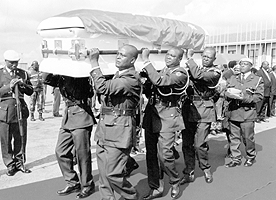
News of the assassination
was conflicting, often confusing. The circumstances of his death were murky and highly
contradictory as foreign missions and media tried to piece the story
together.
Confirmation of Kabila’s demise was not to come until two days
after the shooting, when the Congolese government officially announced that
Kabila had died of his wounds in Zimbabwe where he had been flown soon after
being shot. Leaders of the 14-member SADC, of which DRC is part, worried
about the future of The Lusaka Peace Accord they had pursued for two years
without much success.
The DRC is at the centre of what some have called
“Africa’s First World War”. Six foreign armies are locked in defensive and
offensive positions in the Congo’s most complicated scenario yet. Zimbabwe,
Namibia and Angola have supported the DRC government against rebel forces backed by
Rwanda, Uganda and Burundi. Elements
of Angola’s rebel Unita movement are also said to be part of the rebel
forces.
Diplomatic initiatives at regional and international levels
have failed to decisively end the fighting in the Congo, despite the signing of a
ceasefire agreement in Lusaka in July 1999. Violations occur regularly. Each side accuses
the other of breaking the very peace agreement they have all signed. The volatile
environment probably accounts for the violent end of another of its leaders.
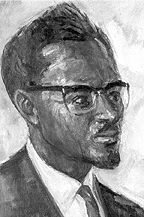
Kabila is the second prominent
Congolese leader to die by the assassin’s bullet; Patrice Lumumba, the country’s
only elected prime minister, in 1961, was killed by pro-western forces, his body
dissolved in acid as the forces of the late dictator, Marshall Mobutu Sese Seko
assumed control of the vast territory.
A complex nation, with a complex ethnic
mix embracing more than 200 language groups and 55 million people spread over 2.5 million
sq km, the Congo is one of the potentially wealthiest countries on Earth. Its history is riven
with foreign interventions: For most of its in-dependent existence, the country has
been a theatre for interventionist politics, causing many thousands of lives to
be lost.
The 1960s secessionist crises in which
Belgian paratroops (ostensibly there to protect foreign citizens), hordes
of mercenaries and UN peacekeepers pitted ideological foes mobilized along
the Cold War divide against each other, culminating in civil war, the rise of
Mobutu and death of Lumumba. |
This time around, the
revolution of 1997 led by Kabila with the backing of Rwanda, and Uganda drove
the ailing Mobutu from the country he called Zaire to seek refuge in a number of
countries and he ultimately died of cancer in Morocco.
Kabila is said to have agreed to
guarantee the security of the Rwanda-Uganda borders once he was assisted into
power. His forces were backed, trained and directed from these countries.
How-ever, after succeeding with the revolution, Kabila fell out with his old allies
who accused him of not honouring their agreement.
His disgruntled Rwandan and Ugandan allies turned on
him and marched on Kinshasa to almost create another major upheaval when, in 1998, a
besieged Kabila sought the help of Angola, Namibia and Zimbabwe, all of whom sent
troops, with Zimbabwe contributing the largest contingent.
|
Patrice Lumumba was also assassinated
|
The three countries secured Congo’s
survival under Kabila but Uganda, Rwanda and Burundi, which supported
several rebel factions, still control nearly a third of the country in its
eastern provinces. The war has driven millions of refugees into neighbouring countries, over a
million are reported dead or missing. The urgency for peace was hence reflected
in the frequency of missions to and from the Congo by SADC leaders.
When the various warring parties were finally brought to
negotiations it was after months of efforts by SADC and the Organization of
African Unity. Once they were at the table, it took several more months of hard
bargaining by Zambia’s President Frederick Chiluba, the chief negotiator, along with
several Heads of State and foreign ministers from SADC as well as UN and international
officials, to try and resolve differences before signing of the peace accord in
Lusaka in 1999.
According to the cease-fire document, cessation of hostilities should
come into force within 24 hours of the peace agreement by all parties including
the rebels (rebels signed the accord almost two months later.) |
The Security Council, acting in
collaboration with the OAU, was to constitute, facilitate and deploy an
appropriate peace-keeping force in the DRC to ensure the implementation of the
agreement and keep the fragile peace.
The inter-Congolese political dialogue and
negotiations were placed under a neutral facilitator – former
Botswana president Ketumile Masire — who un-fortunately was later accused of
favouring the opposition and rejected by Kabila, stalling the peace process further.
Uncertainty was rife when news of Kabila’s death was
announced. Many political analysts did not know what to expect.
Two scenarios — complete collapse of a fragile
nation-state or the ascendancy of new leadership committed to a firm resolution of the
DRC problem were put forward amongst a host of others.
The SADC Secretariat condemned the killing of
Kabila saying it did not “augur well for the process of bringing peace and stability to the
DRC. This assassination also flies in the face of the principles of democracy and
the rule of law to which the SADC region strictly adheres”.
SADC was quick to point to a need for continuity in the
peace process and urged the people of the DRC “to seize this moment to intensify the
search for a lasting and democratic solution to the situation in their country.”
After burying his father, General Joseph
Kabila, 31, eldest son of the assassinated leader, was sworn in as the
new president.
Signals so far from the DRC suggest that the
government is to reexamine the status of Masire as facilitator, probably
with a view to accepting his role in the negotiations.
The road ahead will be difficult for the young leader
and he must face many uncertainties. Angola, Namibia and Zimbabwe have all
pledged their continued support for the DRC, after consultations which will help
the government to stabilize the situation and ward off the threats from the rebels.
Another grueling round of careful diplomacy is necessary
by SADC and the international community to facilitate inter-Congolese dialogue and
lead this troubled country to democracy.
While much of it depends on how far the powerful forces
behind the two opposing sides are willing to resurrect and respect the Lusaka Accords,
some of the responsibility to accommodate one another, will fall upon the Congolese
people themselves.
Another fiasco would have grave consequences for
Africa.
By Kondwani Chirambo |