|
economic front, SADC’s long-conceived free trade area eventually
edged closer to being a reality.
The Trade Protocol, signed by heads of state and
government in 1996, attained the requisite two-thirds ratification in January
2000, allowing it to come into force.
The free trade area was launched
on 1 September 2000. Five countries – Botswana, Lesotho, Mauritius,
South Africa and Swaziland – had, as of January, 2001, deposited
their instruments of implementation. Other countries are reported to
be at various stages of fulfilling this crucial requirement, which is
the first stage in bringing down trade barriers over the agreed-upon
eight-year period.
The stage has, however, been set for
deeper market integration, despite the slow start to lifting tariff
and non-tariff barriers by some member countries.
And with international forums such as
the Smart Partnership Conference (in Maputo) and the International
Herald Tribune Trade and Investment summit (in Windhoek) continuing to
bring to dialogue governments and the private sector in SADC, the gap
in interests between politicians and business is bound to narrow.
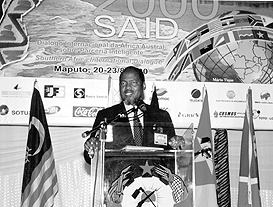
Through the four-year old Smart
Partnership concept — revisited at the September Summit in Maputo —
government, private sector and labour representatives use this Malaysia-borrowed
model to nurture development ideas. The concept is based on the premise that the
three – government, private sector and labour — are indispensable partners in
national development.
Malaysia, which experienced devastating
race riots in the 1960s, and the financial turmoil of 1997, has relied on the
model and the resilience of its people, to return sanity to the economy.
Thus with such a sterling example of how radical home-grown |
seen as arrogant and archaic policies have intensified in
the past year, disrupting all their key meetings.
Relations between the European Union and ACP
(African, Caribbean and Pacific) countries as manifested through the Lomé
Agreement, and more recently, the Cotonou Agreement, have shown that developing
countries can only win the battle against globalization if they fight as a group.
SADC countries, along with other ACP states,
successfully lobbied for continued preferential access to the EU market, which was
granted in June 2000 with the signing in Benin of the Cotonou Agreement, which
succeeded Lomé.
The Cotonou Agreement, named after the Benin city in
which it was signed, runs for 20 years. It has four far-reaching components
relating to trade, financial and technical cooperation, political dimensions and the
involvement of non-state actors.
The question of which facets of
democracy are applicable to which countries dominated election observation in
the region this year. In the Zimbabwe June election, African observers
including those representing the Organization of African Unity (OAU) and the SADC
Parliamentary Forum (an association of 12 parliaments in southern Africa) held
sway over their European counterparts.
In a historic development, the African observer teams
declared the Zimbabwe election free and fair while those from Europe and
America had a different opinion. The ruling Zimbabwe African National Union –
Patriotic Front (ZANU-PF) narrowly beat the Movement for Democratic Change
(MDC) in an election characterized by pre-poll violence.
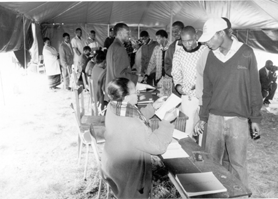
Mauritius, which held its election on 11 September 2000, displayed its own
brand of democracy. The Indian Ocean island uses an unusual system of
choosing its 70-member |
The three elections however, were
criticized by the gender movement in the SADC region, for failing to consolidate
gains achieved in previous elections in terms of women’s representation in
parliament. In all three cases, the number of women members of parliament either
declined or remained stagnant.
Cognisant of the need to increase the number of women
in positions of power, the SADC-PF, in partnership with other institutions, has
embarked on a far-reaching programme to engender the institution of parliament in the
region. At its plenary assembly in Malawi last October, the Forum set aside time to
appraise MPs about the situation of women and men in the region, the same situation
that had led to the executive committing it-self to the 1997 Gender and Development
Declaration.
While the successful holding of
elections in Mauritius, Tanzania and Zimbabwe has helped buttress democracy in
the SADC region, thus help improve waning investor confidence, events in
Angola and the Democratic Republic of Congo have worked in reverse.
In Angola, the peace process remains stalled on a
backdrop of declining region-al and international interest. Similarly, in
the DRC, the UN has failed to complement regional efforts and is yet to send
in a full strength peace-keeping force, almost 18 months after the Lusaka Peace
Accord was signed.
The need for a speedy resolution of the two
conflicts was once more under-scored at the SADC Summit in Windhoek, and subsequent extra-ordinary
summits, especially on the DRC.
The DRC peace process, it appears, has been further delayed by the
belligerents who in the past year have been trading accusations and counter accusations
of violation of the shaky Lusaka Accord.
|
|
IMF surprised many, especially in southern Africa with its decision to sell off
gold reserves on the pretext that it would finance debt relief for countries such as
Mozambique and Tanzania.
First, the IMF misled the world.
Mozambique’s debt, under the Highly Indebted Poor Countries (HIPC) scheme,
has not been cancelled but postponed – Mozambique will still repay at some
stage. Second, the gold sale by the IMF and other countries of the Group of
Seven industrialised countries has plunged far more people into misery than it has
helped – international gold prices have tumbled, turning many mining
operations, including some of those in SADC, unviable.
Many gold mines, especially in South Africa and Zimbabwe — two of SADC’s
major gold producing countries — have shut down, and more are threatened by
the falling bullion prices.
This paradox has served as a sharp
reminder of why civil society has always questioned the secrecy and sincerity of
the Bretton Woods institutions, especially on the back of worsening poverty
among countries “benefiting” from their programmes.
But the globalisation crusade,
championed by the Fund, the Bank and the World Trade Organisation, seems to be
in troubled times. Mass protests against what are increasingly
|
parliament, modelled on the British first-past-the-post elector-al
system but with block-vote modifications.
Sixty-two members are elected from 20 constituencies
where each voter casts three votes for three candidates from each constituency. The
island of Rodriques retains two members also by block vote. Eight members are then
picked from a list of best losers.
The Mauritius election, which was held peacefully and
declared free and fair by the SADC-PF, was won by an alliance of the Militant
Mauritian Movement and the Militant Socialist Movement, ousting the ruling Mauritian
Labour Party.
In Tanzania, the ruling Chama Cha Mapinduzi led by
President Benjamin Mkapa consolidated its position with a convincing victory over its
rivals. Mkapa increased his popular vote from 61.8 percent in 1995 to 71.7
percent this time.
While the election on mainland Tanzania
was generally smooth, the same could not be said of Zanzibar, where
elections in 16 constituencies were postponed for a week after ballot
papers went missing. Zanzibar is a semi-autonomous group of islands
and its people choose their own president and legislature as well as
voting for the Union President and Parliament. The elections on the
islands were finally held, confirming CCM candidate Amani Abeid Karume
as president. |
But while politicians have some
measure of control over the existing conflicts, which inevitably have put a
serious dent on the region’s investment out-look, they will keep their fingers crossed
there is no repeat of events that shook the region at the beginning of 2000 – the
devastating floods.
So severe were the floods that
Mozambique, the worst hit in the region, had to shelve its post-war reconstruction
programme to concentrate on provision of emergency aid, as well as rebuilding
damaged roads and other social facilities.
SADC, which has been cited on many occasions as one of the few regions
that have the potential to succeed, stood firm during the difficult time,
providing material and moral support to the affected countries.
And as more and more of its sectoral protocols come
into force, SADC is set to consolidate its efforts toward regional integration in the year
2001, and reclaim its rightful position as a vibrant economic community of 14 countries.
by Munetsi Madakufamba |