|
Tanzanians give Mkapa a
second term |
The ruling Chama Cha Mapinduzi (CCM) party
and incumbent president, Benjamin William Mkapa scored an overwhelming victory in
Tanzania’s second multi-party elections.
Mkapa, who was challenged by three opposition candidates,
was sworn in at the National Stadium in Dar es Salaam on |

President Mkapa waves at supporters when campaining in the October
general election |
9 November 2000 for his second and last constitutional term
as Tanzania’s president at a brief, colourful ceremony
attended by a number of invited regional leaders.
For Tanzanians who also attended the ceremony or celebrated
the over whelming victory elsewhere in the million sq km country, it was a time for
rejoicing as once again they had demonstrated their regional uniqueness. |
On the main southern island of
Unguja and on the small neighbouring island of Tumbatu, the CCM won all 29 constituencies.
This gave the CCM candidate, Amani Abeid Karume, 67 percent of the popular vote and he was
sworn in as the island’s president on 8 November.
There were, however, clear signs that Karume, whose father
emerged as the island’s first African leader after the |
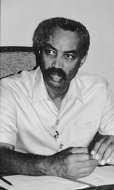
CCM candidate Amani Abeid Karume won the Zanzibar presidency
But the final psychological clincher for many
voters was |
“We have shown southern
Africa and the world that our votes cannot be bought by ethnic and religious political
considerations and appeals,” a Tanzanian political observer noted.
Nevertheless, after the mismanagement of the elections five
years ago,
mainland Tanzanians are clearly irritated that Zanzibaris |

Men and Women stood in separate queues during the 29 October
Tanzanian elections |
have again soiled their image by failing to run their own
elections properly.
Mkapa increased his majority from the 61.8 percent of the
popular vote at his first election in 1995 to 71.7 percent this time. Importantly, he did
so without
the endorsement of Tanzania’s founding president Julius Kambarage Nyerere, who died
over a year ago.
CCM party devastated the opposition taking all but nine of
the 181 constituency seats on the mainland. In the last elections the opposition had won
22 of the mainland seats.
As they had done in 1995, the opposition political parties
once again tried to appeal to ethnic and religious roots. One opponent spoke in the
local vernacular instead of the national Swahili at two campaign rallies. But in the
event, his overtures were rejected and the CCM also regained two of the six seats it had
lost in the Chagga ethnic heartland around Kilimanjaro in 1995.
There had been fears that religious appeals, notably by the
Civic United Front (CUF) party, both of whose candidates on the presidential ballots were
Muslims, would make greater inroads. About one-third of Tanzania’s 32 million
people are Muslims who live mainly along the coast. But the CCM won al
most all the coastal seats.
On Zanzibar, where the elections in 16 constituencies were
postponed for a week after ballot papers went missing, the CCM greatly increased its
majority winning five of the 21 constituencies on the northern island of Pemba.
In 1995, all of these constituencies had been won by the
CUF although the Afro-Shirazi Party (ASP, the forerunner of CCM) had won four seats
previously. |
1964 revolution which ousted the Arab minority (the second
largest minority in Africa after the whites of South Africa), would win the presidency
replacing the CCM incumbent, Dr Salmin Amour.
The younger Karume, then a cabinet minister, had stood
alone in refusing to persecute and repatriate senior Pemba officials from his office when
all other ministers did so following the 1995 CCM electoral defeat.
It was also widely known on Zanzibar that many of the
younger Karume’s own family had previously been members of CUF and his mother, who
has strong roots in Pemba, had assiduously campaigned for him on the northern island.
Zanzibaris were also more conscious this time of the
implications of the United Republic of Tanzania created in 1964 by Nyerere and Karume
senior.
They recognised that a vote for CUF could prejudice the
future of the union upon which Zanzibar is economically heavily dependent.
The island’s 27,000 civil servants knew that it was Mkapa and not the CUF
presidential candidate on the islands, Seif Shariff Hamad, who had paid their salaries in
recent months and that a vote for CUF could jeopardise this arrangement because Hamad was
ambivalent about the future of the union.
The integrity of Nyerere and Mkapa, the latter having
skillfully backed down Amour from running for a third unconstitutional term as the
island’s president, was better known than it had been five years ago. Creek Road in
Zanzibar Town which separates the former African and Arab dwellings, had even been renamed
after Mkapa.
|
that Karume junior had been opposed to some of Amour’s
policies and had been opposed by the increasingly unpopular Amour as the CCM candidate. In
a curious sense Amour’s opposition became an asset for Karume.
Western donors made it clear in private that they
recognised that a win in the island’s presidential race by Hamad spelled disaster for
the union. Karume junior spoke in reconciliatory terms at his subsequent inauguration
indicating that the 18 CUF members held for over two years on treason charges would be
freed in the next few days.
Such reconciliation may go even further. Karume, unlike his
predecessor, was expected to include some CUF members in those he was to nominate to the
island’s assembly and it is clear that he and Mkapa can work together to turn
Zanzibar’s economic malaise around.
Inevitably the opposition parties, humiliated at the polls,
are crying foul. Even if the parallels are not exact, the Tanzanian press quickly
seized on the American electoral deadlock with The Guardian newspaper in Dar es Salaam 9
November headlining “US Joins Third World in Mismanagement of Elections”.
At the end of it all Zanzibaris are looking for a president
who offers reconciliation and prosperity to the impoverished islanders whose main export
earner comes from seaweed farming and not cloves. In Mkapa’s economic achievements on
the mainland, and in his ability to work with Karume, they believe they have now elected
the right people.
By David Martin |
|
|
|
 Issue Contents | Archive | SADC
Today | Editorial Issue Contents | Archive | SADC
Today | Editorial
All comments and queries to
Editorial.
SADC, SARDC,
Web Applications Developer |