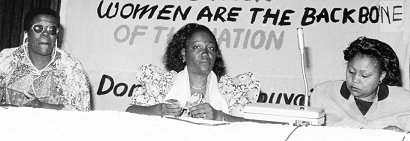
Legislators
are an integral part in the implementation of the SADC Declaration on Gender and
Development and have a mandate to formu-late and implement gender friendly legislation, as
well as facilitating good gov-ernance.
This was said by legislators during a gender intervention
at a plenary assembly of the SADC Parliamentary Forum held in Malawi from 29 October to 3
November 2000. Parliamentarians from around the region attended the meeting.
Delegates explored ways of project-ing and strengthening
the gender agenda within SADC parliaments while also defining the role of parliamentarians
in achieving equality.
MPs also had a chance to review and strengthen resolutions
made in 1997 when governments signed a Declarationon Gender and Development which
committed them to “ensuring the equal representation of men and women in
decision making of member states and SADC structures at all levels and the
achieve-ment of at least 30 percent target of wom-en in political and decision |
SADC PF enlisted the assistance of Southern
African Research and Documentation Centre’s Women In
Development Southern African Aware-ness Programme (SARDC-WIDSAA) and the SADC Gender
Unit to facilitate this activity and provide technical assistance on how to spearhead,
imple-ment, monitor and assess progress of the strategies used to mainstream gender into
political structures. This process is funded by USAID under its regional Strength
programme.
The session was organized using a toolkit designed by
WIDSAA and the SADC Gender Unit which emphasizes the use of a proactive and participatory
approach rather than passive intervention measures. The toolkit will be used for training
SADC decision makers on gender issues.
Participants hailed the session as having been a success.
Leya Chatta-Chipepa, one of the resource persons with WIDSAA, observed that as the meeting
progressed, there was a notable shift from the |
Deliberations focused on:
- bringing the attention of MPs to the commitments made by SADC member states towards the
achievement of gender equality, especially in the 1997 SADC Declaration on Gender and
Development and the 1998 Addendum on the Prevention and Eradication of Violence against
Women and Children;
- sensitizing MPs on the inequalities that exist between women and men in various sectors
in SADC member states, and the fact that gender equality is a critical issue of
development, democracy and human rights;
- sharing with MPs the rationale and importance of decision makers understanding key
gender concepts, as a way of ensuring that they can play a meaningful role in the
achievement of gender equality;
|
making struc-tures by year
2005.”
Statistics on the gender situation in different countries
were presented and the meeting noted with concern that the number of women in key politics
and decision making positions declined dur-ing the last elections. This could mean that
the 30 percent target might prove elusive unless intervention efforts are consolidated.
MPs acknowledged that they have a role to play in improving
their constituencies by enacting legislation that uphold democratic practices and good
gov-ernance, promoting gender equity and equality while implementing the resolutions
of the international conventions signed by their respective governments.
As part of efforts to engender regional parliaments, |
different perceptions and
misconceptions to a deeper appreciation of what gender is and the need to address gender
gaps. The meeting also underlined the need for civic education for both women and men on
gender.
Charity Mwansa, an MP from Zambia and Chairperson of the
SADC PF Committee on Democracy, Conflict Resolution and Gender, summed up the general
feeling among delegates when she
said:
“At the beginning of the intervention, it was clear
that there were a lot of differences in terms of the levels of our understanding of gender
issues. It is my belief that we have come a long way with-in a short period and narrowed
the gap.”
|
- updating MPs on the steps that have been taken to implement the SADC Declaration on
Gender and Development and its Addendum;
- examining the role that MPs can play in the implementation of these instruments, both at
national and regional levels; and
- identifying concrete ways in which the SADC PF can mainstream gender into its policies,
programmes and activities.
By Nomalanga Moyo |