A recent trade and investment conference held in the Namibian capital Windhoek
underscored the need to change negative investor perceptions as a key step in attracting
foreign direct investment.
Participants attending the International Herald Tribune
Southern Africa Trade and Investment Summit added
their voice to the growing sentiment that investors are not coming to southern |
in
the fu-ture.” Investment should seek to raise the standards of living of the
people by giving recipients a stake in indus-tries, he said.
Partnerships between governments and the private sector,
between governments themselves and between the region and the developed world are the
recipe for sustainable development and present the only avenue through which the region
can extricate itself from the web of |
SADC investment rate averaged 16.3 per-cent of Gross Domestic Product (GDP), with strong
influence coming from South Africa which invested about 14.6 percent of GDP, and is
estimated to account for two thirds of total investment in SADC.
Despite these efforts, insignificant foreign direct
investment (FDI) has found its way into the region.
The World Investment |
Africa
because of lack of infrastructure, but perceptions that the region is not stable due to
the wars in Angola and the Democratic Republic of Congo.
Traditionally, investment in sub-Saharan Africa has gone
where the resources are, regardless of political stability Investment has not been
responsive to conditions often demanded |
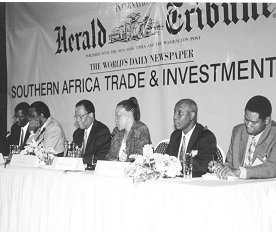
Some Ministers from southern Africa came to answer questions from
investors |
by
foreign investors — liberalisation, pri-vatisation, deregulation or peace and
stability.
Angola, for example, has attracted over US$700 million
worth of investment up to the end of 1999 because of its oil resources despite the fact
that it is at war.
Namibian Prime Minister Hage Gein-gob said “investment
in mining and oil is location specific, but investment in manufacturing is not.”
He called for “inclusive partnerships that involve
Africans themselves. We
ask our partners to consider the region not just as a market, but also a place where goods
can be produced and ex-ported. ” |
poverty, underdevelopment and escalating debt, according to the
international investors who attended the conference.
Many delegates agreed that SADC member states have worked
hard to cre-ate
the right conditions for increased investment and economic growth. The region has been
described as the “next frontier of economic growth in the conti-nent.”
Many SADC countries have embraced development strategies
which have resulted in market liberalisation, fis-cal
restraint, privatisation of state enter-prises.
Acting Chief Economist at the SADC Secretariat, Angelo
Mondlane, gave some interesting statistics. In 1999,
|
Report
2000, shows that in 1999 Africa attracted 1.2 percent of global FDI flows, representing
only five percent of FDIs into developing countries.
Without South Africa, investment levels in the rest of the
region averaged 23 percent of GDP ranging from 8.1 per-cent in DRC to 32.7 percent in
Botswana and a high of 37 percent in Lesotho.
This reflects the anomalies caused by the magnitude of a
few projects relative to the size of the country’s economy. Generally, SADC’s
gross domestic investment as a percentage of GDP compared positively to Africa’s
overall in-vestment including its FDI.
By Grace Buhera |
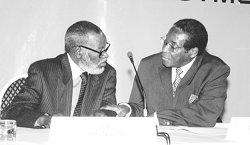 Zimbabwe’s President Robert Mugabe, called for the
correction of “past imbalances to avoid con-flicts
Zimbabwe’s President Robert Mugabe, called for the
correction of “past imbalances to avoid con-flicts