Southern African countries seek to emulate
Malaysia and its south-east Asian neighbours that successfully rode the currency tide of
1997/ 98 through radical home-grown economic recovery programmes.
Through the four-year old smart part-nership concept —
revisited at a recent summit in the Mozambican capital Mapu-to — government, private
sector and labour representatives use this Malaysia-borrowed model to nurture development
ideas. The concept is based on the premise that the three – government, pri-vate
sector and labour — are indispen-sable partners in national development.
After a severe economic shock from the financial turmoil of
1997/98 that hit the entire south-east Asian region, Malaysia rejected assistance from the
International Monetary Fund (IMF) and used local initiatives to put the economy back on a
recovery path. Today Malaysia is the envy of many including southern Af-rican countries.
The southeast Asian country’s gross domestic product
(GDP) stands at US$4,500 per capita, according to World Bank figures. Its savings at 40
percent of GDP are among the highest in the world. With exports outweighing imports, the
country maintains a healthy forex surplus rare among developing nations.
Malaysia’s remarkable record of national resilience
dates back to its years of independence. In 1969 the country faced devastating race riots.
Malaysia is made up of different races that believe in different religions – the
indigenous Malays (most of whom are Muslims), the Chinese who are Buddists, and the Indian
Hindus. Events in other parts of Asia and the Middle East have shown that these religions
are often incompatible.
And to make matters worse, the dis-tribution of wealth in
Malaysia, like many parts of southern Africa, is linked to ra-cial origins.
The indigenous Malays, who form the majority, were (and are
still among) the poorest, while the second largest group made up of the Chinese and
Indians owned a third of the economy, the rest being with the British and other
expatriates.
This domination of ownership of the economy by people of
foreign origin sparked race riots of 1969, which led to deaths, and massive destruction of
property.
The government acted promptly by introducing affirmative
action to bring indigenous Malays into the mainstream of the economy, and |
invited more Chinese and Indians, previously
in opposition parties, to join government.
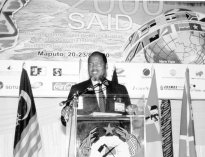
President Chissano addressing delegates in Maputo
The scheme worked so well that racial tensions were
practically eliminated, paving the way for decades of political stability that propelled
Malaysia’s eco-nomic prosperity that it is enjoying today.
And Prime Minister Dr Mahathir Bin Mohamad, a strong critic
of IMF policies, capitalised on the racial harmony and creativity of the Malaysian people
to withstand the currency instability and rebuild the economy.
Addressing delegates at SAID 2000 in Maputo, Dr Mahathir
critised propo-nents of the IMF ideology. He said "in nation building, when caution
is not exercised and care is not taken; when in-terest of people and nations are gambled
upon on the basis of an ‘ideology’, when decisions are not grounded in reality
and the facts are ignored, there will be calamity. The promoters of the ideologies are of
course to blame. But we who make the decision to convert cannot be totally
blameless."
Impressed by the resilience and inventiveness of the
Malaysian people, four southern African leaders who had attended the 1996 Langkawi
International Dialogue, Malaysia’s version of the smart partnership dialogue –
decided to bring the idea to the Southern African Development Community (SADC) re-gion.
The leaders — Presidents Bakili Muluzi of Malawi, Sam
Nujoma of Namibia, Zimbabwe’s Robert Mugabe and former President Sir Ketumile Masire
of Botswana – eventually became patrons of the Southern African International
Dialogue (SAID).
The meeting has been held annually since 1997. This
year’s edition was attended by about 400 delegates from SADC, Africa and the rest of
the world who descended on the Villa Repinga, a sandy recreation park overlooking
Mozambique’s Maputo Bay.
Six marquees were erected, transforming Maputo’s traditional jogging park into a
dialogue village, albeit temporarily.
Host President Joaquim Chissano summed up the purpose of the conference. "The smart
partnership dialogue is an ideas factory," he told delegates. He said the dialogue is
intended to generate ideas and agree on actions that can be implemented independently by
coun-tries or formal organisations as they see fit.
Under the theme, Global Trends and Emerging Economies, the
dialogue was hoped to "give a fresh impetus to the efforts of … organisations
[such as SADC] to achieve sustainable economic growth and regional integration," said
Chissano.
"When tackling natural disasters such as those
suffered by my country earlier this year [the cyclone-induced floods], or devastation
caused by the HIV/AIDS pandemic and malaria, we must be able to benefit from the pooling
of our brains, skills, experience and energy," he said.
President Mugabe dismissed claims that SAID was a mere talk shop. He cited the Chirundu
Bridge linking Zimbabwe and Zambia, and the
Kruger-Gonarezhou- Gaza Transfrontier Conservation Park, as examples of projects developed
out of the smart partnership framework.
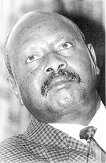
Ugandan President Yoweri Museveni |
Smart partnership dialogues accord
political, business and labour representatives an opportunity to interact in an informal
atmosphere. No agreements are signed, although the meeting may pro-vide the initial
threads the loose ends of which can be tied up later at more formal meetings.
Clad in casual dressing, delegates break up in small
discussion groups where they exchange ideas on specific topics. Team leaders report back
to the plenary, and the process is repeated daily throughout the duration of the meeting.
The discussion sessions are closed to media to
"encourage delegates to express their views freely," said President Chissano.
Although media is mentioned as a fourth partner in the smart partnership framework, many
felt it was given a peripheral role at SAID 2000.
However, the media, as admitted at SAID’99 in
Zimbabwe’s resort town of Victoria Falls, is a key partner in development.
Journalists inform the public about decisions taken by leaders, while at the same time
informing leaders about problems faced by their people.
It is on the basis of this symbiotic relationship that
practising journalists at SAID 2000 wanted to know why they were being represented by
non-practising journalists, most of whom have since assumed different hats in government
or business.
But Chissano gave two reasons. He said for the meeting to
be fruitful, it would not be possible to have every-one attend – it could only be
attended by a limited number of people. Secondly, he said, if ordinary journalists were
allowed in the sessions, naturally they would want to make stories from what are supposed
to be informal discussions.
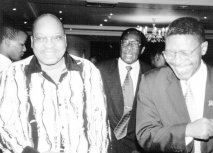
SMART PARTNERS: SA deputy president Jacob Zuma,
Zimbabwe's president Robert Mugabe and Lesotho's Prime Minister, Pakalitha Mosisili share
a joke during SAID 2000 in Maputo
He however, conceded that it was necessary to "engage
government offi-cials and business leaders, labour and media in a much more effective
manner."
There was a significant departure from the 1999 meeting
where there was a special dialogue between heads of state and government, and the media.
SAID 2000 had a separate session on media-related issues which was attended by a select
group of mainly non-practising journalists.
As a way forward, the conference agreed to "establish
an electronic system for accessing news direct from source, rather than from the wire
services" which Chissano said often gave unbalanced perspectives.
A number of hubs have been established at the national
level, such as national economic forums that are now functional in several SADC countries.
SAID 2000 resolved that national hubs needed to be connected to the Commonwealth
Partnership for Technology Management (CPTM), the London-based Secretariat of the
International Dialogue.
This is necessary, said the conference in a final
communiqué, for "exchange of experiences, data and information i.e. webbing for
efficient information flow at national, regional and international levels.
CPTM said it would be willing to as-sist governments engage
in electronic communication among various hubs, as well as in the compilation of a data
bank of business partners and information on business environment in each "smart
partnership member country".
The 2001 edition of the Southern Africa International
Dialogue will be hosted by Uganda
By Munetsi Madakufamba |
