Regional diplomats say they fear a return to open combat in Congo where
increasingly belligerent and contradictory messages are coming from authorities in
Kinshasa.
On the one hand, one of Presi-dent Laurent Kabi-la’s
officials, Leonard Ntuaremba, said that with im-mediate effect the
DRC would allow UN peacekeepers to deploy freely.
Authorization for this long-awaited move came in a letter handed to the UN Organization
Mission in the DRC (MONUC).
Ntuaremba said this confirmed "the will of the
government to see the 5,500 UN forces deployed in the DRC." Up to now only a handful
of personnel have been in the country, the main force of 500 military observers and 5,000
support troops have been unable to deploy across the entire country, in part because of UN
delays and demands for free movement, and also Kabila’s refusal to allow them to
operate in areas of Congo under the government’s control.
However, on the same day the head of the UN mission, Kamel
Morjane, was informed of Kabila’s decision, another Congolese minister told diplomats
in Kinshasa that the government was sus-pending implementation of the 1999 Lusaka
Peace Accord. |
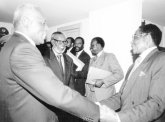
ALLIES: Presidents Dos Santos, Nujoma and Mugabe The ceasefire between rebels
backed by Rwanda, Uganda and Burundi who have been fighting Kabila’s government since
1998 and control parts of the east and north of the huge country, remains tenuous.
SADC allies Angola, Namibia and Zimbabwe are backing the
DRC govern-ment militarily. The ceasefire agreed to in Lusaka in July 1999 and reinforced
recently at a second Lusaka meeting on the DRC conflict has allegedly been ig-nored by all
parties. Veiled threats of using regional sanctions against Kabila were made by some
countries but have not yet been put in place.
During the just-ended UN Millenni-um Summit in New York,
South African President Thabo Mbeki was guarded about major progress towards peace in the
immediate future. "The issues are very complex," he said.
Instead of implementing the Lusaka Accord, Congo’s
human rights minister told diplomats the country wanted to hold fresh, direct talks with
Rwanda, Uganda and Burundi. |
Clarification is being sought
about the apparently contradictory statements by the two ministers as Kabila comes under
increasing pressure from his SADC allies to live up to the commit-ments made at Lusaka.
He has also been severely criticized by the UN Security
Council for establishing a new transitional parliament in what some have described as a
violation of the Lusaka Accord which calls for full participation by all factions in the
country’s political structures.
The 300 deputies were all hand-picked by Kabila from the
country’s 11 provinces including zones held by Rwanda and Uganda-backed rebels.
The transitional parliament, said Kabila, "would share
legislative responsibility with the president." For the past three years, Kabila has
ruled by decree.
The suspension of the Lusaka Ac-cords, threats of sanctions
and what some see as Kabila’s growing isolation has raised concerns that the
19-month-old conflict could become prolonged and serve to further destabilize central and
southern Africa.
By Hugh McCullum |
