As the SADC Parliamentary Forum noted in its
press statement following the landslide victory of the opposition alliance on 11
September, “we recognize the fact that this is a country accustomed to regular,
democratic change of government.”
After a 30-day campaign,
shortest in Mauritian history, some 81 percent of 790,000 registered voters dumped the
ruling Labour Party overwhelmingly, leaving them with only six seats on the 70-seat House
of Assembly.
Navin Ramgoolam, 55, who headed the government since 1995,
smoothly turned over power to veteran politician and former prime minister Sir Anerood
Jugnauth, 73, after a few days of confirming results. He tendered his resignation to
President Cassim Uteem, the ceremonial head of state, who then formally requested Jugnauth
and his partner in an old-new alliance, deputy prime minister and finance minister-elect
Paul Berenger, 56, to form the new government. They won 54 seats.
The remaining 10 MPs consist of two from the offshore
island of Rodrigues whose local parties usually join the winning alliance in the House and
a maximum of eight “best losers” determined statistically by the independent
Electoral Commissioner and ratified by Electoral Supervisory Commission (ESC). The
“best losers” cannot change the election outcome in any configuration but are
allocated to minorities on party lists to redress imbalances in Mauritius’ complex
ethnic and political mix.
Alliance politics and block-voting have been part of
Mauritius political his-tory since long before it gained independence from Britain -
having been colonized earlier by the Dutch and French. Block-voting means that three
candidates must be voted for in each of 20 main island constituencies and two on
Rodrigues. Ballots are invalid if more or less than three are marked.
The new ruling alliance known popularly as MMM/MSM is an
equal partnership formed from Jugnauth’s Militant Socialist Movement and
Berenger’s Militant Mauritian Movement. Ideologically both are similar, and both have
been in alliance |
with
each other — and with other political formations as well — be-fore.
Indeed the same alliance brought Jugnauth to power in 1991
when he served as prime minister for 13 years until 1995, but without Berenger who split
early on and went into opposition. In another irony, Berenger joined with the Labour Party
in 1995 to wipe out completely his old colleague and partner, and swept the 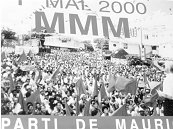
High voter turnout marked the election
main island’s 60 seats but within months Ramgoolam and Berenger were
squabbling and the MMM leader was soon back in his accustomed role as leader of the
opposition.
Indeed the burning political issue and subject of intense
scrutiny and debate among pundits since the latest victory and alliance, is whether
Jugnauth and Berenger can keep it together. Days after parliament was dissolved on August
10, their two parties signed up for another alliance whereby Jugnauth would become prime
minister, the most powerful position in government, for three years. In that time the
ceremonial presidency would be changed by constitutional amendments to add certain powers,
including the power to dissolve parliament, and extend Uteem’s term by one year. By
that time Jugnauth would retire as prime minister, to be elected president by the House of
Assembly, and Berenger would at last hold the job he has coveted most in more than 30
years in politics, and become prime minister for the remaining two years of the
government’s life.
But Berenger has split at least three alliances in the
past. “If he does it this time, he’s finished even though he’s very
popular. The electorate will never trust him again and Jugnauth’s finished too.
He’s too old to wait out his five-year term and take up the presidency because
with-out Berenger they can’t make the constitutional amendments,” says former
Supreme Court justice and legal consult-ant Vinod Boolell.
Mauritians really had no other issues to debate
except the personalities of the two alliances. Its economy is strong and predicted to
reach |
eight
percent growth in GDP this year, its per capita income is more than US$3,500, inflation
and unemployment are low, around five percent. There is little crime and although
petty corruption charges against two cabinet ministers (who immediately resigned)
precipitated the snap election call, few people believe corruption in government is
serious.
The country of 1.2 million is a passionate ethnic mix of
the descendents of African slaves, Asian indentured labour, a multitude of varying
religions and languages (although English is official, Creole is common and widely used by
all). It has no army and no armed uniform police, only a small, usually unarmed, Rapid
Response Force, a kind of mini-SWAT squad.
A loyal member of SADC - the current Acting Executive
Secretary, Prega Ramsamy, is a Mauritian. The Parliamentary Forum had the singular job of
being the first official mission to ever observe a Mauritian election. It was a bit from
the sidelines since the electoral laws here have not been amended to allow anyone but
electoral officials, police, party agents and, of course, voters to come within 200 m of
the voting centres.
SADC-PF said there were many lessons to be learned. The
massive turnout of voters after huge peaceful political rallies was encouraging.
“The exuberance of the crowds was self-evident.
Security (unarmed) was tight but not intimidatory. The political climate was charged but
without violence. An air of maturity and tolerance permeated the country,” a press
statement said.
Perhaps the main downside to the election was the lack of
participation of women. Only 33 candidates ran from among more than 40 parties and
inde-pendents. Only four were elected, all from the winning alliance, a drop of two from
the last parliament.
“In the prevailing situation, the target set by SADC
governments in their Gender Declaration to achieve 30 percent women representation in
parliament and other decision-making processes by 2005 will prove difficult to
achieve,” said the SADC-PF.
By Hugh McCullum |
