When
Tanzania’s estimated 11 million eligible voters go to t e polls on Sunday 29 October
2000, they will be confronted by a bewildering array of choices. Mainland Tanzanians will
vote for three separate candidates: Zanzibar islander’s for five.
On the mainland the electorate will vote separately in
presidential, parlia-mentary and local government elections.
On Zanzibar, they will vote for the President of the United
Republic of Tan-zania, the President of Zanzibar, their member in the mainland parliament
as well as the Zanzibar House of Representatives, and finally for their local government
candidate.
Unlike in the country’s first multi-party elections
five years ago, the electorate will have to complete this exercise in one day instead of
two and the elections on Zanzibar will this time not be held a week earlier than those on
the mainland. Results are expected late on Monday 30 October 2000.
In all a total of 231 constituency seats are at stake in
the united republic parliament. A further 30 seats are reserved for women and these are
subsequently awarded on a proportional basis to the parties whose candidates are returned.
The elected President nominates a further ten members while the Tanzanian attorney general
automatically takes a seat.
Despite so many choices facing the electorate, one thing is
already certain. The present incum-bent of the Tanzanian presidency and choice of the
ruling Chama Cha Mapinduzi (CCM) party, Benjamin Wil-liam Mkapa, will be returned to
office for a second term.
In his first election in 1995, he won just over 62 percent
of the vote. This time, observers predict, he will increase his majority.
In 1995, his main opponent was Au-gustine Mrema, a former
CCM cabinet minister who led the presidential chal-lenge
for the National Council for Construction and Reform (NCCR) party. This time Mrema, after
public divisions within the NCCR, has switched allegiance to the moribund Tanzania Labour
Party (TLP) which observers believe is likely to be relegated to third place in the race.
Mrema, a Chagga from the Kilimanjaro region, appealed to
and won that e hnic vote in 1995. The end result was t at for the first time since
independence in 1961, there was not a Chagga Minister in government. The |
industrious
Chagga took to referring to Mkapa as “shemeji”, the Swahili word for
brother-in-law, because of his Chagga wife.
Another candidate who in 1995 tried unsuccessfully to play
the Sukuma ethnic c rd was John Cheyo of the United Democratic Party 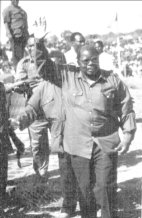
President Benjamin Mkapa
(UDP).
But, unlike other countries in the region, such
factionalism among Tanzania’s 120 plus ethnic groups is generally frowned upon and
Cheyo seems likely to prop up the list of presidential aspirants.
The person most likely to come second in the presidential
race is Dr Ibrahim Lipumba, the candidate of the Civic United Front (CUF). He is a Muslim
(Mkapa is a Catholic) and former professor of economics. Lipumba is likely to appeal to
and win the votes of some fellow Muslims, particularly those along the coast in centres
like Kilwa and Pangani.
In Mkapa’s first term he has laid the foundations for
his second — and for his successors — and he has built on the national unity
created by his late mentor, Julius Nyerere, who as Tanzania’s first president is
known as “Baba ya Taifa”, the “Father of the Nation”.
In a nominal sense, and until his death late in 1999,
Nyerere, despite having formally retired as the country’s president 14 years earlier,
was in all but name
the president of Tanzania to whom the people (including Mkapa) looked for guidance.
While the future of Mkapa and mainland Tanzania is fairly
predictable, that of Zanzibar remains uncertain and nowhere in the united republic does
the ghost of Nyerere cast such a historic long shadow.
It was Nyerere, who with the island’s first African
leader, Sheikh Abeid Amani Karume, created the United Republic of Tanzania in 1964
bringing together the two sovereign states of Tanganyika and Zanzibar.
What followed is often referred to as a form of
disproportional representation that has not always been comfortable. Such an argument,
while superficially true, ignores the two countries |
equal
sovereignty.
Now Karume’s son, Amani, a minister of the CCM
Zanzibar government, is running against the CUF leader, Seif Shariff Hamad, for the
islands’ presidency and control of the House of Representatives.
Dynastic politics will have little to do with the outcome,
most of the Zanzibar electorate being “born frees” not knowing their own history
and the Arab-African divide which led to the 1964 revolution. The outcome is now too close
to call.
In the disputed 1995 election, which led to a three-year
CUF boycott of the House of Representatives, CUF won all of the constituencies on the
northern island of Pemba and made inroads into the constituencies on the main island of
Unguja.Were CUF to win in 2000, it would put Mkapa in a difficult position as the United
Republic of Tanzania president. CUF could secede returning Zanzibar to its former
sovereignty in the forlorn belief that the Arab world would prop up its battered economy.
Alternatively Mkapa could confront the unenviable task of
ruling a union as the CCM president with two opposing, elected political parties and a CUF
president on Zanzibar.
It is an option he will hope to avoid with Amani Karume
winning on the day by retaining the Unguja constituencies and making inroads into Pemba.
In Mkapa, aged 62, Tanzania has east, central and southern
Africa’s first third generation President. In many
ways he is far from the traditional political leader. He was persuaded by his friends and
supporters to run for the post in the first place because “it was my national
duty” and he has no ambitions of remaining in office after his second term.
He is a committed democrat and party man. His background
includes peri-ods
in the civil service, journalism, diplomacy and politics and he is clearly moulded by
Nyerere’s principles and tutelage.
But now, without his mentor, Mkapa stands alone ready, one
senses, to more vigorously pursue their shared agenda for Tanzania, as he faces his second
and constitutionally final term on his own.
By David Martin |
