Following are excerpts from a
statement to the media by the SADC Acting Executive Secreatary Prega Ramsay on 5 Sept
following the launch of the Free Trade Area on 1 Sept 2000.
… As you know the SADC Protocol on Trade was
signed in 1996 in Maseru, Lesotho and came into force on 25 January 2000. Since then there
have been negotiations on the operational-isation of the protocol. The negotiations
centred on tariff reduction schedules, rules of origin, dispute settlement mechanism,
special trade agreement on sugar, elimination of non-tariff barriers and harmonisation of
customs and trade documentation and clearance procedures. Agreement was generally achieved
on all these issues hence the launch of the Free Trade Area on 1 September 2000.
One may ask what exactly does this mean? The launching of the Free
Trade Area by SADC does not mean that a Free Trade Area has been achieved in the region.
We are just starting to reduce our tariffs and eliminating non-tariff barriers to
facilitate increased trade among SADC countries. The actual Free Trade Area will be
achieved after eight years when 85 percent of all trade in the region will be traded at
zero tariff/duty. The launching of the SADC Free Trade Area is therefore just a beginning
of a process that will take us about eight years to accomplish.
The reduction of tariffs under the protocol will be carried
out on the basis of three categories. Goods which fall under category A, will have their
current duties reduced to zero immediately after tariff schedules are gazetted by each
member state. On average, as the coverage varies from country to country, 47 percent of
goods traded in the region will be at zero duty levels.
There are goods, which fall under category B, which
are subjected to gradual tariff reduction over the eight-year period. For these goods, in
some member states tariff reduction starts in year 2000 while for some they start in year
2001 or 2004. This takes into account the level of development for each country. However,
it is expected that by 2008, 85 percent of all goods traded in SADC will have achieved the
zero duty level.
Category C, has goods classified as sensitive products,
which mostly fall, in the area of security, health and safety considerations and to some
extend infant industry. These goods constitute 15 percent and tariffs would be |
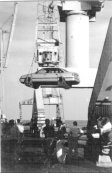
Motor Industry is one of the outstanding
issues in the negotiations
eliminated by year 2012. I should however point out that
those goods, which fall under article 9 and 10 of the protocol, as exclu-sion would not be
part of the goods to benefit from preferences. Summit also adopted an amendment to the
protocol to the effect that the SADC Protocol on Trade preferences do not cover trade in
second hand goods. This means that if second hand goods are traded, import duties at
existing levels prior to tariff reductions will prevail.
I also want to explain that trade in sugar had originally
been classified as sensitive subject to a special agreement. There have been negotiations
on trade in sugar, which as you know is a sensitive product even world wide hence its
market price remains distorted. The open market price for sugar is lower than the price
exporters obtain from preferential markets such as that provided for under the EU-ACP
Agreements and the US General Systems of Preferences (GSP). For our region, we have agreed
that ini-tially, sugar producers should have access to the large SACU market includ-ing
the SACU producers themselves.
A market growth share has been agreed upon which will see a
steady increase in sugar tonnage exports into the SACU market until 2012 when total
liberal-ization of the SADC market is expected to take place subject to the developments
on the world market. Market access is based on a country’s exposure to the world
market on trade in sugar, and not to prefer-ential markets. ...
The area of clothing and textiles is yet another area where opportunities are being opened
up under this new trade regime. As you may be aware, trade in clothing and textiles will
be based on a two-stage substantial transformation rule of origin. However, for countries
like Malawi, Mozambique, Tanzania and Zambia, the SACU group agreed to allow these
countries to access the SACU Market under a one-stage transformation rule subject to
quotas. The quotas are based on current production capacity. |
This dispensation will be in force
for a period of five years during which these countries are expected to graduate to the
two-stage transformation rule of origin where there are no limits on market access, that
is there are no quotas. Import duties in this sector are being reduced gradually. There is
a clothing and textiles committee, which will continuously monitor trade in the output of
the sector and take corrective measures as necessary.
A Dispute Settlement Mechanism was also adopted at the last
Summit in Windhoek, Namibia as part of the amendment to the SADC Protocol on Trade. The
mechanism provides for complaints by member states in terms of implement-ing the trade
protocol against another member state to be launched with the Trade Implementation Unit
which would facilitate the resolution of such disputes through consultations, good offices
and panel of experts. The ruling by Panel of Experts once adopted by the Committee of
Ministers of Trade is final. Disputing member states are expected to implement the
decision. ...
The commencement of the implementation process does not
imply that negotiations have been finalised. The nature of trade agreements is such that
you continue negotiating to improve the trade regime. In our case we still have the area
of automobile industry outstanding.
We envisage to come up with a development oriented
agreement, which would ensure that all member states that are currently producing motor
vehicles do benefit. The trade Negotiating Forum will soon be working on trade in services
with a view to open up that for regional trade.
The ministers responsible for trade have agreed to meet
every month in order to have hands on monitoring of the implementation of the protocol on
trade. The ministers will be able to take decisions and resolve any problems that may
arise. They will also be taking cognisance of the developments at the WTO and the world
trading system in general.
In order to assist in the implementation of the protocol, …Council
at its meeting in Windhoek, … established a Trade Implementation Unit at the
secre-tariat. The TIU will initially be staffed by experts seconded by member states while
the normal recruitment procedures are being undertaken........ |
