|
After
40 years of independence from Belgium, the Democratic Republic of
Congo (DRC) is still at step one in its attempts to rid itself of four
decades of violence, corruption and the collapse of most of its
social, political and economic institutions.
On 30 June 1960, Africa’s second largest country, saw
the colonial power leave with the most minimal levels of education,
health and infrastructure and five days later Congolese troops
mutinied against their Belgian officers.
This event sparked the beginning of 40 years of conflict
and corruption supported by western countries during the Cold War.
Ironically, as the sombre ceremonies marking Independence Day on 30
June 2000 took place in the capital, Kinshasa, the United Nations (UN)
was trying to gather an insubstantial force (MUNOC) to help end
two-years of civil war, much as it did 40 years ago when peacekeepers
were sent to help the newly independent government.
The DRC’s history is one of numerous foreign
interventions, dictatorship and invasions, leaving one of the
continent’s potentially richest territories little more than a vast
battlefield.
From the time of first President Patrice Lumumba’s
assassination by pro-Western agencies who propped up his successor,
Mobutu Sese Seko who changed the country’s name to Zaire and ravaged
DRC’s untold wealth of mineral resources for his own use, to his
eventual overthrow in 1998 by Laurent Kabila, the country has been
underdeveloped and at the mercy of one foreign power or another.
Even as Kabila was marking the anniversary, alongside
Belgian Foreign Minister Louis Michel, the armies of Rwanda, Uganda
and Burundi were slugging it out in the north and east of the country
with their rebel forces pitted against Congolese forces supported by
their SADC allies .
Military analysts describe it as one of world-war
dimensions, yet it is virtually unheard of except for the occasional
flurry of attention such as the recent pitched battles between former
allies Rwanda and Uganda which ended only after
the country’s third city, Kisangani, was ravaged leaving more than
500 dead and thousands wounded. The two armies have now pulled back in
a shaky ceasefire to 50 km north and south of the city.
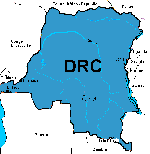
DRC
The statistics of the civil war are appalling and
outrageous as the UN dithers and the Lusaka Peace Accords are
regularly violated by rebels and their Ugandan and Rwandan
backers.
|
-
Most of these
deaths have been a result of the
destruction of the health and food infrastructure, already ruined
by Mobutu’s abject neglect;
-
The misery of
DRC’s citizens inherited from
Mobutu’s 35 years in power is seen in the hospitals
without medicines and staff, schools permanently closed,
roads which are impassable, telephones and postal services which
cannot function and fear a constant impact on their lives.
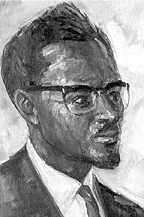
The late President
Patrice Lumumba
The myriad of rebel factions and ethnic insurgents
supported by Uganda and Rwanda subverted the Lusaka Accord signed in
July 1999 by all parties. Efforts by the Southern African Development
Community (SADC) of which DRC is a member, the Organisation of African
Unity (OAU) and the UN are unabated but fighting continues,
flaring up and dying down as factions within factions struggle for
control of the huge underdeveloped country of nearly 50 million spread
over 2, 345,410 sq km.
Earlier this
year, following meetings in New York with the Security Council
by the heads of state of countries involved in the DRC, the UN
approved a small force of 5,500 soldiers and observers to be drawn
largely from African countries to try and police the revived Lusaka
Accord. So far only a handful of UN soldiers are in the country as an
advance party.
African analysts rightly question the UN’s commitment: in Sierra
Leone, one-30th the
size of DRC, there are nearly 12,000 troops and in tiny Kosovo
in former Yugoslavia, 42,000 peacekeeping troops have been
deployed. To the casual observer, the on-going fighting in DRC is
simply between Kabila and his SADC supporters and his former Rwandan
and Ugandan allies who helped him overthrow Mobutu in May 1998.
Kabila was sworn in as president on May 22 of that year. The reality,
however, is much more complex.
Kabila and his allies control much of the southern
diamond rich areas where there is now relative peace. The rebel
movements are supported by the three Great Lakes countries but
their unity has disintegrated resulting finally in the all-out battles
that raged in Kisangani in mid-June, while 30 unarmed UN observers
attempted to broker a ceasefire, themselves in grave danger from the
warring countries and rebel movements.
Many consider the DRC conflict to be intimately connected to several
other conflicts in the Great Lakes region. In-deed,
its genesis is in the Hutu-Tutsi conflict that resulted in Rwanda’s
1994 genocide where the UN also failed to halt the deaths of almost a
million people. Many members of the former Rwanda regime fled into DRC
and actually helped Kabila overthrow Mobutu.
|
The conflict is also linked to the long-running Burundian civil
war, which pits a Tutsi military against ethnic Hutu rebel factions.
Uganda’s President Yoweri Museveni and Rwanda’s President
Paul Kagame were once close friends and allies but following the
Kisangani violence have created yet another complexity for those
struggling to bring peace to DRC. Kofi Annan, the UN’s
secretary-general, who was head of peacekeeping during the Rwanda
conflict, appears reluctant to send troops until the seemingly
endless breaches of the ceasefire have ended.
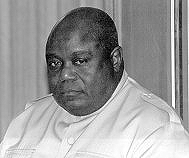
President Laurent
Kabila
Both the OAU and SADC have been heavily involved in
attempts to end the war. The three SADC armies supporting Kabila have
expended huge amounts of money while the 14 nations have used all
their diplomatic clout to broker and maintain the Lusaka Accords of
which President Frederick Chiluba of Zambia has been the principal
mediator with wide support from the rest of SADC.
The OAU appointed former Botswana president, Sir Ketumele
Masire as a facilitator in the conflict. Kabila, however, will no
longer meet with Masire and has closed the OAU office in Kinshasa,
claiming that the facilitator is biased against him.
Masire argues that two parallel approaches are needed.
The UN peace-keeping force envisaged by the Lusaka Accord and approved
in January by the Security Council is one aspect of a solution. The
other, says Masire, is dialogue among the Congolese. "I am
leading the dialogue approach," said Masire.
Even as the latest ceasefire seems to be holding,
enormous damage to an already weakened country has been done. Hundreds
of thousands of refugees and displaced persons from the many regional
conflicts around the Great Lakes have created a crisis so severe that
Sadako Ogata, UN High Commissioner for Refugees, made a special trip
recently to meet signatories of the Lusaka Accord " be-cause
peace and stability are so important for the region."
DRC is the linchpin in the region she says. Observers,
including those from SADC, see her as an unofficial envoy from Annan
in another effort to bring peace to a country too long at the
mercy of invaders.
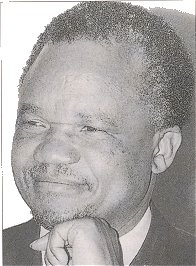
President Frederick
Chiluba
|
