|
Angola
has been at war since 1961.Its history of struggle against
colonialism, apartheid, foreign interference and criminal rebellion
has now moved into the 21 st century. Hundreds of thousands of
Angolans have been killed and maimed, while millions are
displaced.
Much of its potentially rich economy has been damaged and
social development set back by decades. The impact of the war on
neighbouring Namibia, Zambia and, indeed all of southern Africa, has
been extremely negative. Peace has been delayed too long by the
so-called rebel movement, Unita and its shadowy supporters in the
underworld of arms peddlers and illicit traders.
Recent reliable estimates claim that Unita has
"earned" US$4 billion from the illegal sale of diamonds to
buy arms to wage war against Angolans.
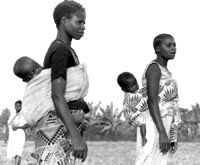
Emergency aid required for some two million Angolans
due to Unita terrorism, most of them women and children.
The conflicts have raged despite almost endless attempts by
Angolans themselves, by the international community, by the UN and by
SADC, which as a community has suffered alongside its member state in
order to end the war.
Jonas Savimbi, Unita’s leader, who was declared a war
criminal by SADC in 1998, continues to defy the very Lusaka
protocols signed in his name.
The peace initiatives brokered by Angola and broken by Unita
are legion: from the 1991 Bicesse
Agreement which led to the 1992 presidential and legislative elections
which Unita wrecked by refusing to recognize the outcome of the
voting; through the 1994 Lusaka Protocol,
abandoned
unimplemented in 1997 as Unita defied every aspect of the ceasefire;
to the international prohibition of diamond purchases from
Unita-controlled areas of Angola in 1998 and the close of the
|
UN’s
mission by Angola for its failure to keep peace in 1999
and the
establishment of a Sanctions Committee.
In absolute disregard of democratic norms, the West
demanded that the Angolan government share power with Savimbi, instead
of urging him to accept the 1992 results.
"If that is the rationale (of sharing power
with those who have lost elections), why are we obliged to go for
elections if the objective is to share power," Georges Chikoti,
the Angolan Deputy Minister of Foreign Affairs told a recent workshop
in Maputo, Mozambique.
The workshop, was an effort to renew waning international
commitment to the peace process in Angola.
"In all democracies in the world,
it is the winning party that rules while the
minority stays in the opposition. Why a double standard in
Angola?" asked Chikoti, a former Unita official, who blames
Western hypocrisy for the continued conflict.
Nonetheless, the government agreed, through the 1994
Lusaka agreement, to share power with Unita. Positions in government
were given to Unita, while deputies went into Parliament. Savimbi
though never came to Luanda to take up his post as
vice-president.
"If Savimbi did not fulfill the provisions of Lusaka
(accord), there is no other negotiation that will suit
him," declared the deputy minister of a man who has lost the
trust of many of his own lieutenants.
Each time Angola has returned to war,
the consequences on
the civilian population have been aggravated. Today four million
people are displaced and in need of humanitarian aid; more than two
million have died since 1975; more than 400,000 have been
orphaned and 80,000 mutilated.
And, although UN Secretary-General Koffi Annan says
Unita "bears the responsibility
for the return of war to Angola" the international community
seems unwilling to do little more than wring its hands in frustration,
unable to implement the absolute sanctions it imposed on the movement
which it describes as "bandits and terrorists."
|
The most recent report from Annan to the Security
Council in mid-July says Unita continues to engage in guerrilla
activities across parts of Angola creating insecurity and fear among
civilians.
The Angolan government recently called for a boycott of the
Organisation of African Unity (OAU) summit meeting in Togo on 12
July because President Gnassingbe Eyadema, among others, had been
implicated by the UN sanctions committee in assisting Savimbi in
exchange for illegally mined diamonds.
The issue of "conflict diamonds" was
first brought to international attention when Ambassador Robert
Fowler of Canada revealed in a detailed report to the UN the
extent of illegal diamond sales to perpetuate the Angolan terrorism of
Unita. Fowler called for the sanctions against Unita to be extended to
diplomatic sanctions against third parties.
The sanctions have met with some success with the recent
decision in Ant-werp, Belgium by the diamond industry to choke off the
traffic in diamonds of war fuelling Unita’s ability to continue its
terror, along with rebel movements in Sierra Leone and DRC. Although
these diamonds constitute only four percent of world production,
processes have been set in place to eliminate them.
While the Angolan army has scored some major victories
over Unita in the last six months and now controls vast areas of its
national territory, Unita’s attacks on civilians in remote and
isolated areas continues. The humanitarian situation is appalling in
parts of the countryside. Some four million people remain vulnerable
and displaced and face wide-spread hunger and malnutrition.
Rumours which have been circulating that the
government of President Jose Eduardo dos Santos is holding
"secret talks with Unita" have been roundly denied by the
speaker of Angola’s Parliament, Roberto De Almeida who criticized
those who are pressuring the government to once again engage in peace
talks with Savimbi.
By Hugh McCullum and Munetsi Madakufamba |
