|
Poverty,
peace and stability in Africa were the main challenges that confronted
the participants at the 21-23 June economic summit in Durban whose
theme was "The African Economic Renaissance: Making it
Happen."
Known as the Southern African Economic Summit, the
conference is co-chaired by SADC and the World Economic Forum.
Issues discussed included the role of business and government in
the battle against AIDS, poverty eradication, debt implications on
development, peace and stability, trade and in-vestment as well as
globalisation. Other issues which attracted interest, in the wake of
recent developments in Zimbabwe, were land reform ,as well as disaster
management, following the floods that hit Mozambique and other
countries early in the year.
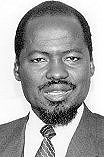
President Joaquim Chissano
Addressing the summit,
Mozambican President Joaquim Chissano explained that for the African
renaissance to be successful, Africa should be independent from rich
countries. He said the continent should strengthen its fight
against corruption and mismanagement of public resources, and promote
peace and respect for human
rights. He also stressed the need to bring peace to Angola and the
Democratic Republic of Congo (DRC) both member countries
of SADC of which he is the current chair.
Prega Ramsamy, SADC Acting
Executive Secretary, said the African Economic Renaissance
"implies the renewal of
the continent. This should be based on the recognition of its failures
and difficulties, and its potential for development. Africa must move
into the main-stream of the world economy, and face up to the
challenges of globalisation".
Trade
and investment flows into the continent
came under the spotlight. Although global foreign direct investment
(FDI) has increased four-fold during the 1990s to a staggering sum of
US$850 billion, the share
apportioned to the emerging.
markets, including SADC, averaged around 30 percent.
|
Chissano lamented the ever-widening gap between the
developed world and Africa despite the latter’s efforts in putting
into place measures aimed at creating a conducive environment to
attract foreign investment.
Also noted were the glaring disparities in terms of expenditure
in key sectors such as education, health and other social services
which have "impacted negatively on the standard of living and
quality of the life of the African masses."
Professor Anthony Hawkins of the University of Zimbabwe argued
for globalisation and regionalisation to open markets. A policy
of open regionalism with low external tariffs is needed and he noted
that of the US$2.1 billion FDI inflow into sub-Saharan Africa, the
lion’s share is split between Nigeria and South Africa.
There was strong support from panelists for a new round of
World Trade Organisation (WTO) negotiations as a vehicle through which
developing countries could achieve their goals in the organisation. A
negotiated approach to globalisation is needed given the fact that
countries in different parts of the world are not starting from an
equal footing.
Commenting on the level of development assistance to the
region, President Benjamin Mkapa of Tanzania, said that promoting good
governance, fighting corruption and wooing foreign investors were
marginal
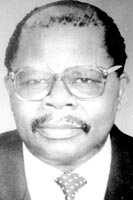
President
Benjamin Mkapa
to the larger problem of how to get the Eurocentric Organisation
of Economic Cooperation and Development (OECD) to "put their
money where their mouths are."
Since the 1960s, he said, "approaches to foreign economic
developmental assistance had shifted from aid to trade and
back to aid, with the yardsticks changing all the time. Now aid
through NGOs is being stressed as a means of stimulating economic
growth that fits in the
framework of globalisation. Today trade and foreign investment are
falling, and foreign aid has yet to reach promised
amounts."
|
South Africa’s Minister of Finance, Trevor Manuel, said
privatisation of industry had robbed African countries of a key source
of revenue, putting it instead in
the hands of foreign shareholders. He described a generally hopeless
situation of governments with too much debt and too little foreign aid
to better the lot of rural Africans. As a result, talk of improving
the investment environment and tackling the continent’s social and
political problems are unrealistic.
Peter Hain, a junior minister in the British foreign
office for Africa, argued that responses need to be found to the
"privatisation of conflict". He said in Angola it is no
longer South African apartheid and the US Central Intelligence
Agency aiding the rebel Unita now the war is funded by diamonds
and oil and fuelled by shadowy business concerns in Europe and Africa
who profit from arms and logistics supplies. Africa is awash with
small arms, which represent one of the greatest threats to peace, Hain
said.
AIDS, which is increasingly reversing economic gains, needs
more resources to be channeled towards the development of vaccines.
Seth Berkley, President of the International AIDS Vaccine Initiative,
pointed out that less than two percent of US$20
billion spending on AIDS in Africa was directed at vaccine
development. Since 1998, four vaccines have been put on trial, two of
them with African partners. This approach is to offer license rights to manufacturers who offer the lowest cost to end-users and the
highest access.
On land reforms, Prof. Sam Moyo, a Zimbabwean land expert, said developments on the land issue in
Zimbabwe had to be seen in the political context. “The problem is to find a balance in increasing the number of
small farmers while deracialising the land issue.” Although agreeing that the immediate effect of farm
invasions was a 10 percent loss of production on commercial farms, coupled with losses caused by poor tobacco
prices and delays in marketing, he argued against the idea that redistribution destroys the economy.
There is increasing evidence that small farmers
occupying optimum space are more productive than large-scale farmers, he said. "As soon as the [farm] invasions
[in Zimbabwe] are resolved and there is a repackaged land reform deal, we will see a reversal in the fall in
production."
|
