| by Tinashe Madava When the
manufacture and use of landmines was banned under the Ottawa agreement in 1997, SADC
member states welcomed the international treaty as a positive step towards accessing vast
tracts of landmine infested regions they could use for economic development.
Two years down the line, efforts to stop the manufacture and use
of anti-personnel mines in most conflict-ridden countries in the region seem to have
yielded little as allegations of armies laying anti-personnel mines and subsequent
accidents continue to flood the international media.
According to Jerry White, of the Landmine Survivors Network, the
average cost of treating a landmine victim is US$9,800. Addressing a recent session of the
Maputo conference of signatories to the Ottawa treaty outlawing anti-personnel mines,
White said that multiplying this figure by the estimated number of landmine victims
worldwide gives a figure of some US$3 billion. The figure includes the rehabilitation of
health services in mine-affected countries required to treat the victims.
However, the International Campaign to Ban Landmines (ICBL) said
it was very difficult to obtain accurate data on the number of landmine victims and the
amount of money spent on treating them.
Since most of the countries affected are poor, and many are still involved in conflicts,
the data-collecting mechanisms either do not exist or are inefficient. As the health
services do not have access to accurate data on landmine victims, they are unable to plan
properly.
Mozambique’s Social Welfare Minister, Acucena Duarte,
stressed the need for “community participation in rehabilitation and social
reintegration”.
Duarte said that one of her ministry’s main concerns was
“data collecting so that we can have full information on the number of accidents and
victims, and identify the areas where there are suspected mines”. |
Meanwhile, the Angolan
government has been criticised for its continued use of landmines in their civil war
against UNITA rebels. Angola signed the Ottawa treaty in December 1997, and although it
has not yet ratified it, other signatories expect the Angolan government to abide by its
terms. Yet within months of its signing Angolan troops were laying fresh mines in parts of
the country affected by the war with the UNITA rebels. Angolan
Deputy Foreign Minister Toko Serrao admitted the charges, and said his government would
continue to use anti-personnel mines because “our country is at war”.
Meanwhile Mozambican president Joaquim Chissano says his
country’s development has been “retarded by three generations of land
mines”.
He said it would take Mozambique 160 years to clear the estimated
two million mines strewn across the country. Since the start of a demining operation in
1993, 60,000 mines have been unearthed at a cost of US $116 million - one of the highest
figures for any demining programme in the world, according to a report by the ICBL.
In its report, ICBL said one of the biggest obstacles to demining
was funding. It noted: “Humanitarian mine action programmes are underfunded, and
often funding choices do not support the long-term integrated approach needed in
sustainable humanitarian mine action.”
Mine awareness is also cited as a crucial part of any anti-mine
action programme. According to ICBL: “Mine awareness involves information programmes
to reduce the threat of landmines to affected communities.” At the signing of the
Mine Ban Treaty in Ottawa, an estimated US $500 million was pledged by donors to support
mine action programmes. The ICBL quotes a recent Canadian government report which stated
that 10 donors had started 98 new mine action programmes in 25 countries over the last 12
months. However it added that many of the programmes were military-to-military demining
training exercises and it was “unclear how much of the money actually goes to lifting
mines out of the ground.” |
According to ICBL, one
suggestion to increase mine action was to ask countries to donate one percent of their
defence budgets. It adds that between 1988 and 1998 the global annual average for defence
spending was US $74 billion. One percent of this figure would give an estimated US $740
million to mine clearance programmes annually, helping to resolve the problem in less than
a decade. The US government has provided almost 27 million
US dollars since 1993 for demining activities, including eight million dollars for
surviving land mine victims. However, the US, like China and Russia, has not signed the
treaty.
President Bill Clinton has announced a target date for signing of
2006 (by which time he will have been out of office for six years), and even this is
conditional on finding some other weapon to replace anti-personnel mines..
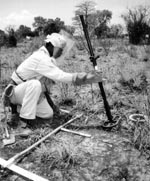
Landmine removal is costly and dangerous
Mixed reactions to SA-EU trade
Laying an institutional foundation for the
trade protocol
The SADC trade protocol & gender:
What are the connections? |