| Before the
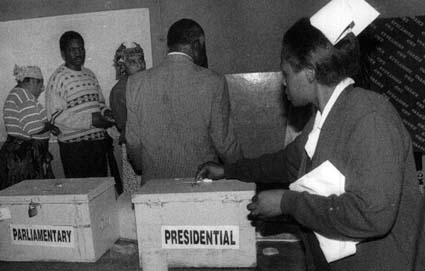
millennium dawns, five elections will have taken place in southern Africa. Botswana,
Malawi, Mozambique, South Africa and Namibia prepare for the events this year, while at
least four other SADC countries will hold their elections between the year 2000 and 2001. The
elections will be an indicator of the status of democratic development ten years on. More
importantly, the proximity of the events provides space for a region genuinely committed
to a shared agenda of integration, to take stock of each member state’s commitment to
the tenets of democracy and good governance.
The process begins with Malawi on 25 May, a country that produced some of the most
highly competitive legislative elections five years ago. South Africa follows on 2 June
and will provide a further insight into the workings of the Proportional Representation
(PR) electoral system which a growing number of political players in the region are
beginning to favour.
In the 1994 elections, President Bakili Muluzi’s United Democratic Front (UDF),
took 48 percent of the seats with 46 percent of the votes, the Malawi Congress Party (MCP)
32 percent of the seats with 34 votes, and the Alliance For Democracy (AFORD) 20 percent
of the seats with 19 percent votes. This translated into 85 seats for UDF, 56 MCP and 36
AFORD.
In South Africa, the African National Congress (ANC) is set to dominate the elections
as it did in 1994. The issue now is whether the minority-based parties can prevent the ANC
from obtaining a two-thirds majority in parliament which will allow it to change the
constitution without reference to the opposition.
Under the List-PR electoral system, the smaller parties were able to gain seats in
parliament. Seven parties in all were represented based on the percentage vote claimed.
The ANC won 252 seats, the National Party (NP) 82, the Inkhata Freedom Party (IFP) 43,
the Freedom Front (FF) nine, the Democratic Party seven, the Pan Africanist Congress (PAC)
five and the African Christian Democratic Party two seats.
Labour migration in southern Africa
SADC in pictures
Toward a SADC peacekeeping
force
Conflict in Angola
DRC: stalled peace talks
Co-operation between SADC Central Banks
|
Deputy President Thabo
Mbeki, who took over at the helm of the ANC after President Nelson Mandela retired as
party leader in March 1998, will be looking for a second ANC victory. President Mandela,
who led the ANC to the historic victory in the 1994 first democratic elections, retires
from active politics after the elections in June.
In addition to the parties that were in the 1994 elections, more new opposition parties
will be contesting the June 1999 elections, notably the United Democratic Front (UDM) of
former ANC member Bantu Holomisa and former NP leader Rolf Meyer.
President Festus Mogae, who took over from former president Sir Kethumile Masire in a
smooth transfer of power in 1998, will lead the Botswana Democratic Party (BDP) into the
next elections expected in early October this year. The ruling party has been in power
since independence from British rule in 1966.
Namibia, which won its independence from apartheid South Africa in 1990, is looking
forward to its second presidential and legislative elections this year. The last
elections, won by the South West African People’s Organisation (SWAPO), were held in
1994.
President Sam Nujoma, who got the nod from the Namibian parliament to contest a third
term after his two terms |
prescribed in the
constitution expire this year, will lead SWAPO into the coming elections. In late
October or early November, Mozambique is expected to hold its second general elections
after the devastating civil war which ended in 1992. The last elections were held in 1994
and were won by Frelimo.
The ruling party, headed by President Joaquim Chissano, will contest the coming
elections against a host of opposition parties led by Renamo, the former rebel force.
Angola was supposed to have gone to polls in 1995, but political instability in the
country resulted in an indefinite postponement. With the renewed fighting between
government forces and the rebel movement, Unita, it may not be possible to hold immediate
elections in Angola.
On assuming power in 1997, after ousting the late dictator Mobutu Sese Seko, President
Laurent Kabila had said his country would hold elections by June this year. However, like
Angola, the ongoing war between the DRC government and Rwanda/Uganda-backed rebels has put
into doubt any immediate elections.
Elections in Mauritius and Tanzania are expected next year, while Zambia’s are due
in 2001. Zimbabwe will hold its legislative elections in 2000 and presidential elections
in 2002. |