| Information technology key theme for SADC Conference in Lusaka |
“The overall objective of the conference will be to share information and exchange ideas on the important and critical role being played by information technology in communications and in shaping economic and business strategies at the global, regional, national and micro-enterprise level,” says a statement from the SADC Secretariat in Gaborone, Botswana.
SADC’s cooperating partners, business leaders, representatives of government, labour and private organisations, non-governmental organisations and the civil society will engage in open dialogue during the conference. It has become tradition for SADC to hold consultative conferences (CCs) on themes that are critical to the organisation’s overall objective of achieving regional cooperation and integration. The theme for the 1996 CC held in South Africa was “Trade and Investment” while “Productivity: Key to Sustainable Development in SADC” was the focus of the 1997 CC which was held in Namibia. After the Windhoek Consultative Conference, the Council of Ministers adopted a decision not to hold consultative conferences annually. As a result, there was no CC in 1998. Other issues include globalisation and financial markets, as well as human resources development. The Lusaka conference will be preceded by sectoral working group meetings and interactive group sessions on 11 February. |
|
|
Recent advances in information technology have become a major determinant
of investment destinations in the global economy. The 1999 SADC Consultative Conference in Lusaka, Zambia, on 12 February will focus on information technology, in recognition of the increasing importance of that this new challenge has had on global competitiveness.
Information about investment opportunities can now be easily transmitted all over the world through Internet and it has become common for investors to visit different web sites before they decide on which market to explore. Under the theme, “SADC in the next Millenium: The Challenges and Opportunities of Information Technology”, the SADC conference will seek to raise awareness and initiate debate on the subject.
|
||
| Smart partnerships needed to improve information technology | ||
|
by Munetsi Madakufamba
|
||
|
The advent of Internet has made the world of communication look simple. It has greatly reduced the cost of communicating between regions and has become a critical factor in development. However, the fact that Internet is heavily reliant on modern computerised technology has prevented many developing countries, SADC included, from fully enjoying the dividends that come with the “information superhighway”. While the use of Internet and electronic mail (e-mail) has spread quite rapidly through southern Africa, it has been confined to major cities, denying access to the more than 70 percent of the population that live in rural areas of the region.
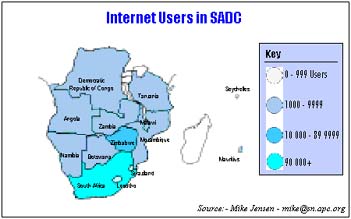
With few, often old and unstable telephone lines in many parts of SADC, and Africa in general, Internet services will remain a pipe dream for the populace for sometime to come. It requires a computer with the appropriate software, a telephone line and relevant skills for one to be hooked on to the Internet. However, the cost of acquiring a computer, opening and running an account with a local service provider and the monthly telephone bills are beyond the reach of many SADC citizens. Available statistics show that there are only 14 million lines for the 700 million people in Africa. According to Mike Jensen, a South African-based Internet expert, there are between 800,000 to one million Internet users in SADC or one user for every 4,000 people. Just over three percent of the total for the region is outside South Africa. With 10,000 users in Zimbabwe, the other 20,000 are shared among the remaining 12 member states. |
However, the figures only show users in the sense of account holders, which can be shared by many more people. In that regard, the actual number of people with access to Internet services would therefore be much higher, but still lower than the world average which is one user for every 40 people. In North America and Europe, the average is about one in every four to six people. International connections are often carried either via satellite or, in the case of South Africa for instance, via the marine optical fibre link to the hub in the Canaries. Most Internet service providers in SADC connect through the South African hub. Jensen says service providers in southern Africa are subsidising their counterparts in the North as the former are required to meet the entire cost of connection to Europe and the US, thus further increasing the cost of Internet in the region. Although poor infrastructure and other factors have kept Internet services comparatively higher in Africa than in Europe and the US, they remain far lower than other telephony services. For instance, it costs far less to send a message by email than by fax, which explains why email messages account for most of the traffic on the Internet. To keep the costs down and affordable to the common folk, SADC needs to invest heavily in telecommunications. The global telecommunications sector, which ranks third after banking and health as the world's fastest growing sectors, is expanding at seven percent per annum, twice the growth rate of the world economy. Growth has remained far below that level in many SADC countries and governments are beginning to realise why this has been the case — the sector has remained predominantly a state enterprise. |
South African Minister for Posts, Telecommunications and Broadcasting, Jay Naidoo, believes growth in the SADC telecom sector has not matched the world rate because of lack of concrete partnerships between the governments and the private sector. Such partnerships, says Naidoo, would develop a climate for sustainable investment that offers good returns on investments whilst at the same time contributing to social upliftment.
While SADC countries have made inroads in privatising state enterprises, the telecommunications sector has remained largely untouched. Although many reasons have been given, including the widely cited one that telecommunications is a strategic industry that cannot be left in the hands of profit-driven trans-nationals, the sector has not convincingly adapted to technological changes. However, some countries have already begun to enjoy the benefits of public-private sector partnerships. South Africa’s Telkom recently went into partnership with two foreign companies, SBC Communications of the USA and Telekom Malaysia. The sale of 30 percent of Telkom SA to the two partners brought in US$1.261 billion and represented the largest foreign direct investment for infrastructure development into the country. A strong affirmation for private-public sector partnerships has been underlined during the two annual forums on Smart Partnership in Southern Africa - one in Botswana in 1997 and another in Namibia in 1998. The 1999 Smart Partnership in southern Africa will be held in South Africa. |
| Country | ISPs | Users |
Inter- Bandwidth (Kbps) |
Call Cost
(US$/hr) |
Internet Density Population /User |
Speed (Users/Inter. Kbps) |
|
|
||||||
| South Africa | 75 | 900,000 | 600000 | 1.6 | 49 | 15 |
| Zimbabwe | 17 | 10,000 | 2000 | 4.00 | 1,192 | 5 |
| Tanzania | 14 | 2,500 | 1098 | 1.94 | 12,876 | 5 |
| Mozambique | 6 | 3,500 | 384 | 0.8 | 5,340 | 9 |
| Namibia | 6 | 2,000 | 1000 | 1.00 | 827 | 2 |
| Botswana | 6 | 1,000 | 640 | 0.60 | 1,551 | 2 |
| Mauritius | 6 | 1,000 | 896 | 1.00 | 1,154 | 1 |
| Angola | 5 | 1,750 | 192 | 6.00 | 6,838 | 9 |
| Zambia | 3 | 3,000 | 256 | 1.6 | 2,897 | 12 |
| Malawi | 3 | 2,000 | 128 | 1.56 | 5,189 | 16 |
| Swaziland | 3 | 900 | 64 | 0.95 | 1,036 | 14 |
| Seychelles | 1 | 1,000 | 128 | -- | 76 | 8 |
| Lesotho | 1 | 200 | 10 | -- | 10,920 | 21 |
| DRC | 1 | 200 | 64 | -- | 246,040 | 3 |
|
|
||||||
| Total/Average | 147 | 929050 | 66860 | 1.7 | 149 | 8.2 |
|
"Internet Density" is the ratio of population to users
"Users/Int Kbps" is the number of Internet users for every 1 Kilobit per seconds of the total International bandwidth |
||||||