|
Once explosive Lesotho is calm after the intervention of the South African and Botswana troops, under the SADC banner, to stop chaos after opposition parties refused to accept the May election results in which ruling Lesotho Congress for Democracy (LCD) was declared winner.
Some of the South African troops have since withdrawn from Lesotho following restoration of peace in the country.
A total of 3,500 Botswana and South African troops were deployed in Lesotho in September to restore peace and order, after civilians with tacit backing of the army decided to put law into their own hands.
South African Deputy President Thabo Mbeki has stressed that the SADC peacekeeping force would only withdraw from Lesotho when peace is restored.
|
Political parties in Lesotho have accepted a SADC proposal to hold fresh elections in the next 15 to 18 months. There was an initial disagreement on who was to govern the country in the run-up to the polls. The LCD has agreed to work with an interim government which will include representatives from opposition parties and other interested groups in Lesotho.
The Langa Commission, which investigated allegations of rigging in the country's May elections, found that the Independent Electoral Commission (IEC) had mishandled the exercise, but fell short of calling for fresh elections.
|
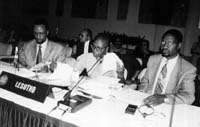
Lesotho delegation at the SADC summit in Mauritius.
Lesotho, surrounded by South Africa, has been wracked by political turmoil, including coups, since attaining independence in 1966. SADC member states have, on several occasions, restored peace in the mountainous kingdom of about 2.1 million people.
|
|
SADC statement on Angola
|
|
Following are excerpts from the SADC statement on Angola.
The Heads of State or Government of the Southern African Development Community meeting at the 18th Annual session from the 13th to the 14th September 1998 at Grand Baie, Republic of Mauritius have thoroughly examined the prevailing situation in Angola on the light of the extensive briefing provided by His Excellency Jose Eduardo dos Santos, President of the Republic of Angola.
The Heads of State or Government concluded that the peace process in Angola and all its related efforts both by the Government of the Republic of Angola and by the international Community are being hindered by Unita's constant and deliberate non-compliance with the implementation of the Lusaka Protocol, the relevant resolutions of the security Council and the laws of the Republic of Angola.
Considering the delaying tactics engineered by Unita, the process of implementation of the Lusaka Protocol has been frustrated for the past four years. ...
|
The Heads of State or Government of SADC consider Jonas Malheiro Savimbi as the person solely responsible for the increasing deterioration of the security situation in Angola and the tragic consequences which have been felt throughout the region over a long period, by stubbornly and persistently opting for war as a means of seizing political power and, to this end, continuing to train men inside the country and abroad, recruiting mercenaries and increasing his military arsenal through all possible means.
The Heads of State or Government concluded that the behaviour of Savimbi is that of a war criminal and, thus renders him objectively incapable of leading his party onto the road of peace in Angola. ...
Heads of State and Government praised the tireless efforts being made by the Angolan Government in bringing about peace in Angola, within the framework of the Lusaka Protocol, and urged the International Community to render its full support in order to facilitate the social integration of demobilised soldiers and the involvement of all Angolan citizens, who opt for genuine peace, in the process of peace and national reconstruction of Angola.
|
|
|