| CURRENT ISSUES | trade | |
| Lomé negotiations begin |
Many analysts say if developing countries are expected to be at the same level of development as the industrialised, there is need for a gradual exposure to international competition, and not an "overnight" change as required by the WTO.
SADC and most ACP states are in agreement that if the status quo cannot be maintained, a ten-year waiver should be sought to allow affected countries adequate time to position themselves for the new world order. The EU has over the years been an important destination for SADC exports such as beef and sugar under the Lomé trade provisions. SADC member states have between 20-50 percent of their exports directed to the EU where the margins of preferences are superior to all other preferential trade arrangements extended to developing nations by the developed countries. |
|
|
Lomé negotiations commenced in September 1998 with some hope that parties involved would salvage a new agreement that will help to define the future economic opportunities of many of the world's poorest countries.
The negotiations which involve the European Union (EU) and the broad group of African, Caribbean and Pacific (ACP) countries were top of the agenda during the recent SADC-EU parliamentary and foreign ministers meetings in Vienna, Austria. Non-governmental organisations (NGOs), including Eurostep are optimistic about the outcome of the negotiations but are worried about the risks facing poor people if the civil society does not exert enough pressure on the negotiating parties. |
"Concerted pressure from European and ACP civil society will be needed throughout the negotiation to ensure an agreement which is ambitious enough to tackle the enormous challenges to development, and which contributes fully to enhancing the livelihoods of poor people and reduce the risk of war," says Eurostep, a coalition of European NGOs.
The Lomé Convention is an agreement that provides a framework of aid and trade between the ACP countries and the EU. It was agreed on in 1975 and will expire in February 2000, the very time by which a new framework should be in place. The preferential treatment given to the ACP, including SADC, violates the new World Trade Organisation (WTO) rules which require that such treatment be extended to all other developing countries at the same level of development. However, SADC along with other ACP countries, is fighting to change rules and policies which could exclude poor and vulnerable economies and block international collaboration for achieving objectives such as the eradication of poverty through sustainable development as set out in the international commitments made at Rio de Janeiro, Copenhagen, Beijing and Cairo. |
|
| Protocols usher in new phase for SADC |
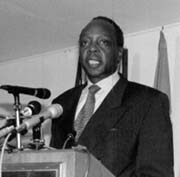
Mozambican Prime Minister Pascoal Mocumbi who officially opened the meeting in Maputo But the repairs could not be carried out, she said, because the financial resources needed were not there. In fact the railways did not even dispose of sufficient funds to reduce the backlog of priority work. The protocol strengthens SADC's new spirit of smart partnerships as it marks the shift away from government-run transport systems to much greater involvement of the private sector. |
|
|
SADC is entering a new phase in its programme of regional integration with the recent ratification of some of its protocols.
Speaking at a recent SADC/European Union conference on implementation of the SADC transport protocol in Maputo, SADC Council of Ministers, South African Foreign Minister Afred Nzo said this was one of three SADC protocols that had now come into force. "Since they [protocols] are, in fact, the building blocks of the community, it is evident that this new phase is of the utmost importance", he said. The conference was a joint initiative of the SADC Transport and Communications Commission (SATCC) and the government of Austria, which currently holds the EU rotating presidency. The Protocol on Transport, Communications and Meteorology, signed in 1996 in Lesotho and ratified by 10 SADC states, excluding Lesotho and Zambia, is now in force. The DRC and Seychelles which joined SADC last year are yet to accede to the protocol. Officially opening the meeting, Mozambican Prime Minister Pascoal Mocumbi stressed that "the integration of southern Africa will remain incomplete, if it is not accompanied by an integrated network of communications which by opening up the markets of each of the member states, permits the circulation of goods and the movement of people, for business or for tourism". |
Mocumbi's views were echoed by Benita Ferrero-Waldner, the State Secretary for Foreign Affairs of Austria, who added that in a globalised world of open markets and free movement, transport provides the essential links between regions, countries and peoples.
"Transport stimulates economic growth, increases investment and spreads prosperity throughout a region", she said adding "transport means linking production areas with their potential markets, thereby generating additional, much needed income in marginalised regions". The Austrian diplomat however, warned of some of the drawbacks such as environmental and social problems, and the fact that transport infrastructure needs continuous, sometimes costly maintenance and upgrading, irrespective of short term profits. Ferrero-Waldner cited one example of severe funding constraints. Austria had financed a study into the condition of railway track in the SADC region, which found that "in some countries the situation is alarming and urgent repairs are needed". |
|