| SADC appeals for more foreign direct investment | ||||
|
Efforts by southern African countries in opening up their markets
and creating an investment friendly climate have not been complemented by sufficient foreign direct investment especially from Europe.
This was said by SADC Executive Secretary, Kaire Mbuende, at the joint third SADC-EU joint ministerial meeting in Vienna, Austria on 3-4 November. "We are concerned over the declining Overseas Development (ODA) which contrary to conventional wisdom is not being replaced by trade and investment. "There is a role for ODA as an expression of international solidarity and as a mechanism for social justice among nations," he told the meeting which was attended by representatives of foreign ministries from the EU and SADC. He said SADC countries were implementing sound economic policies which had in many instances resulted in declining budget deficits, low inflation rates and positive economic growth. "Notwithstanding all these efforts, foreign direct investment particularly from Europe is slow in coming," he said. A major EU-SADC Investment Promotion Programme, which aims at creating a mechanism to facilitate trade and investment between the two regions, is currently being worked out. |
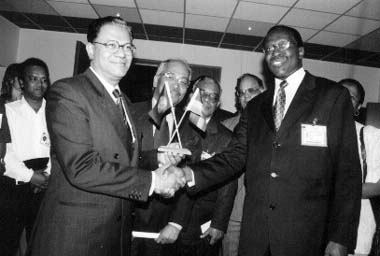
Mauritius Prime Minister Navinchandra Ramgoolam meets SADC Executive Secretary, Kaire Mbuende at the Summit in Grand Baie, Mauritius
|
|||
| DRC: Rwanda admits involvement | ||||
|
There are rays of hope for peace in the troubled Democratic Republic of Congo
(DRC) after Rwanda admitted that it has troops in the country.
Following intensive diplomatic persuasion by the SADC chairman President Nelson Mandela of South Africa the Rwandese government admitted that it has soldiers in the war-torn central African country, thus paving the way for peaceful negotiations. The SADC allied forces called in by President Laurent Kabila to repulse the invading forces had insisted that unless Rwanda and Uganda make clear their involvement in the war, no negotiations would be entered into with the rebels. Several regional summits have been held to try and find a solution to the conflict in Africa's third largest country. However, most of them ended in deadlock due Rwanda's refusal to acknowledge their involvement in the conflict. Recent efforts include the October Lusaka talks chaired by Zambian President Frederick Chiluba, who was tasked at the last SADC Summit in Mauritius to mediate in the negotiations. The meeting was attended by foreign affairs and defence ministers from the allied countries, as well as rebel leader Wamba dia Wamba. Mutombo Kabindji, spokesperson of the Union for Democracy and Social Progress - one of the rebel groups - said a plan was forwarded to the UN Secretary General Kofi Annan as part of the "quest for peace" and follows a recent call by opposition leader Etienne Tshisekedi for a meeting with Kabila. However, fighting continues and the government said it has launched an offensive against the rebel-held town of Kalima in the eastern part of the country. Government and allied forces have increased the number of troops to retake the key eastern town of Kindu occupied by the rebels. The war in the DRC started in August after the rebels, backed by Rwanda and Uganda, turned against the Kinshasa government. |
||||